01 · AI Circularity Ledger
Open Weights Still Need Expensive Machines
A commercial loop with a scoreboard.
An open-weight model can arrive with a wonderfully small download price and a remarkably large moving bill. The permission travels easily. The machine that makes the permission useful still needs somewhere to live.
Reflection’s October 5 preview of Beam makes the distinction unusually visible: 501 billion total parameters, with 23 billion active. Its weights and technical artifacts are promised later this month. The conclusion is straightforward: open weights can expand control and competition while leaving a substantial physical and operating bill. Counting active parameters alone will not tell you whether the model fits your machines. Reflection’s announcement
That is a more useful starting point than declaring either the death of closed models or the permanence of a particular chip supplier’s advantage. A prospective operator needs three answers. What may I do with the model? What must I keep available to run it? What does a reliable service cost at my actual demand?
Those questions lead to different spreadsheets. Mixing them produces an exceptionally confident purchasing mistake.
A permission is not a machine
Open weights can give an organization meaningful choices. It may be able to select a host, inspect a deployment, modify an allowed component, or keep a service running without asking the original provider to answer each request. The exact license and supplied artifacts determine which choices exist. A promise to publish under a permissive license still needs to become an actual release that someone can inspect.
Beam is useful here as a live question rather than a completed procurement answer. Reflection describes a preview and limited early access, with the broader release still ahead. I would keep its expected license, released files and tested runtime as separate entries. An announcement can establish the plan; it cannot establish that a particular operator has downloaded a working package.
Once files are available, another set of questions begins. Can the team reproduce a basic result? Can it restart the service? Does its data remain within the intended boundary? Can it identify which version produced an answer? These are the ordinary inconveniences that turn model access into an operational capability.
None of that diminishes openness. It identifies the work that openness allows the operator to take on. Control has value precisely because the operator can make choices. It also means someone has to make them, maintain them and pay for their consequences.
The experts still need somewhere to wait
A sparse mixture-of-experts model uses a subset of its parameters for a particular token. That can reduce the computation involved in producing that token. It does not mean every other parameter has ceased to exist. The service still needs a way to make the required experts available when different tokens call for them. Hugging Face’s explanation distinguishes active computation from the broader memory demands of these models. Mixture of Experts Explained
Imagine a specialist workshop. A job goes to a few specialists rather than every person in the building. You have saved simultaneous work. You have not automatically eliminated the desks, reference materials and coordination needed to keep the other specialists available for the next job.
The analogy has a limit: software can move and compress weights in ways people cannot move their desks. An implementation may distribute experts, offload them or use lower precision. Each choice has implications for memory traffic, latency, quality and operational complexity. There is no universal machine count hidden inside the active-parameter figure.
For a buyer, the practical mistake is to compare a sparse model’s active count with a dense model’s total count and treat them as identical deployment footprints. They describe different aspects of the work. Ask for the actual serving configuration and measured behavior under the workload you intend to run.
A small calculation catches a large confusion
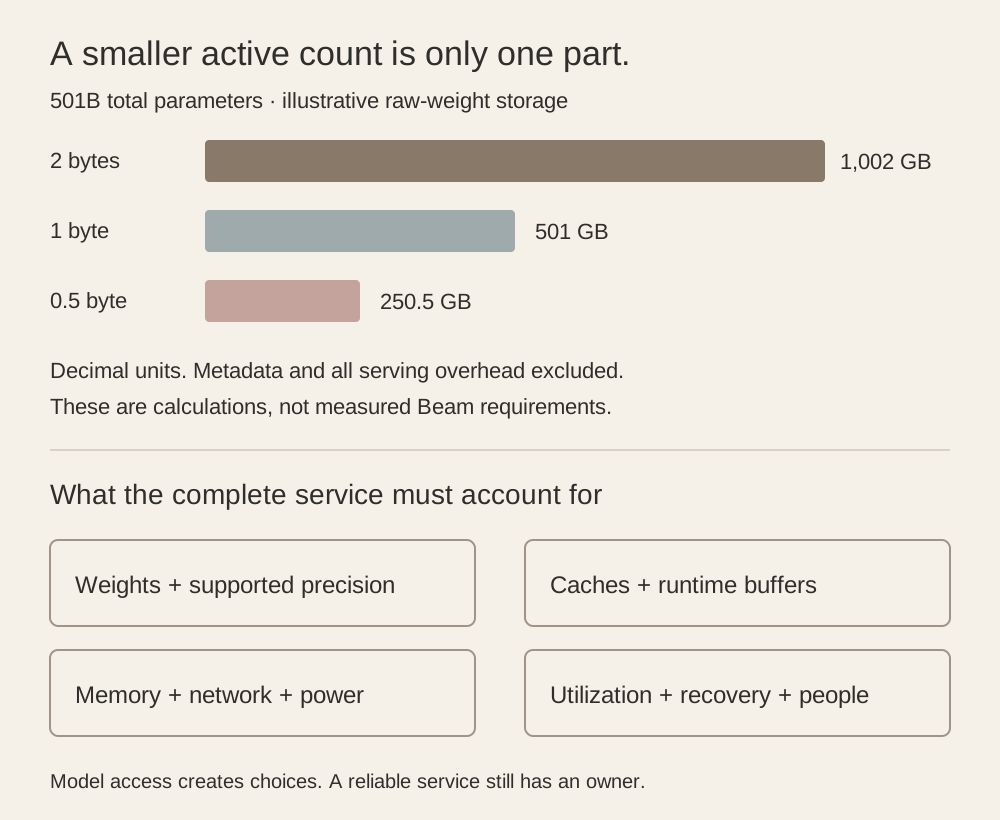
Here is an explicitly hypothetical storage calculation using Beam’s announced total parameter count. If every one of 501 billion parameters occupied two bytes, raw weights alone would occupy 1,002 billion bytes: 1,002 GB, or 1.002 TB in decimal units. At one byte each the arithmetic becomes 501 GB. At half a byte it becomes 250.5 GB.
These are illustrative weight-storage quantities, not observed Beam requirements, supported deployment recipes or recommended purchases. They exclude scale factors and other quantization metadata, caches, activations, buffers, runtime overhead and redundancy. They also say nothing about how much of the model a particular implementation keeps on each device at a given moment.
NVIDIA’s memory troubleshooting documentation gives the underlying heuristic: total parameters multiplied by bytes per parameter, divided by tensor parallelism for a simple per-device estimate. It explicitly lists additional allocations beyond weights. NVIDIA memory guidance
Applying the same two-byte arithmetic only to 23 billion active parameters gives 46 GB. That is a calculation about a subset, not evidence that the complete model can be served in 46 GB. The roughly 21.8-fold difference between total and active counts should prompt a deployment question, not a claim of a 21.8-fold cost penalty. Computation, storage and service cost do not move in lockstep.
Compression changes the question again
Lower precision can make a large model more practical. Hugging Face documents eight-bit and four-bit loading techniques that reduce memory demands. Its documentation also explains configurations and offloading choices; the existence of a technique is distinct from support for a particular new model and runtime. Quantization documentation
The tempting shortcut is to take a smaller storage number and carry every other property over unchanged. A responsible comparison checks whether the chosen representation preserves the quality that matters, works with the intended tools and meets the latency requirement. A compact model that produces more rejected work can consume an apparent saving elsewhere.
That does not imply compression must damage quality or speed. The point is that the outcome is empirical and configuration-specific. Record the representation, runtime version, hardware arrangement and test cases together. A result that omits these details cannot tell the next operator what to reproduce.
For a small organization, a smaller model with adequate capability may be a better starting point than an ambitious model squeezed into an awkward environment. There is no prize for exhausting memory elegantly. The useful prize is a service that completes the intended job and recovers when an ordinary dependency fails.
The training bill belongs to a different owner
Reflection says its reinforcement-learning run used 10,500 NVIDIA GB300 GPUs over four weeks and generated more than 100 million rollouts. Those are company-reported training details. They are neither an audited cost account nor the hardware specification for a customer’s inference service. Reflection’s training description
This distinction matters to the phrase “Nvidia tax.” It can be a useful prompt to examine where value accrues, provided it does not become a substitute for measurement. Training expense, a supplier’s margin, a hosting charge and an operator’s idle capacity are different economic objects. Adding them rhetorically does not create an observed tax rate.
An organization downloading weights usually does not rebuild the original training campaign. Its question is the cost of serving, adapting and operating the released artifact. The developer’s training investment matters to business sustainability and future releases, while the customer’s deployment bill depends on its own configuration and demand.
The two can influence each other without being interchangeable. A well-funded training program may produce an efficient deployable model; it may also produce a model whose attractive capabilities exceed a small operator’s practical resources. The decision waits for the released package and measured workload. A photograph of a training cluster cannot settle it.
Availability is a service you build
Putting weights on a machine is the beginning of service ownership. Users also encounter queues, timeouts, failed tools and version changes. A team must decide what happens when a request stalls, which data is retained and how it detects an answer that should not be accepted.
Memory use changes with the service, too. A long conversation and several concurrent requests can create different cache demands from a short, single-user demonstration. NVIDIA lists caches, activations and communication buffers among the allocations beyond weights. The total footprint therefore needs to be measured at the intended operating conditions, not inferred from a model file alone. NVIDIA memory guidance
A hosted service bundles some of these responsibilities into its price and contract. Self-hosting moves more of them into the operator’s schedule. Either arrangement can be sensible. The comparison should name which party owns updates, capacity planning, incident response and recovery, because an omitted responsibility often reappears as someone’s evening.
For autonomous work, recovery is especially consequential. A model may reason well while the surrounding service loses progress after an interruption. I would ask for a restart demonstration and a retained result before treating a long run as dependable. This essay proposes that check; it does not claim to have executed it on Beam.
Empty machines have excellent benchmark scores
Consider a purely illustrative monthly decision. Suppose a reserved deployment costs $12,000 in fixed capacity and operations, plus $0.02 per attempted job. A comparable hosted option costs $0.20 per attempted job with no fixed charge in this simplified example. Ignore quality differences for a moment so the arithmetic stays visible.
At 10,000 attempts, the reserved option costs $12,200, or $1.22 per attempt, against $2,000 hosted. At 100,000 attempts it costs $14,000, or $0.14, against $20,000 hosted. The break-even point is about 66,667 monthly attempts: $12,000 divided by the $0.18 difference in variable cost.
These numbers are invented teaching inputs, not quotes from Reflection or any cloud provider. Real offers can contain minimums, volume discounts, support charges and capacity constraints. The example isolates one mechanism: lower marginal expense can coexist with a higher total bill when usage is sparse.
Then restore the quality question. If configurations produce different acceptance rates, compare spending per accepted outcome while retaining every retry and rejected attempt in the numerator. The cheaper attempt may be the more expensive job. Also check whether the required concurrency fits the reserved capacity. A financially attractive volume is useless if the machine cannot serve it when demand arrives.
Another chip does not remove the coordination work
Alternative hardware can expand negotiating and engineering choices. Anthropic’s April announcement describes using AWS Trainium, Google TPUs and NVIDIA GPUs, alongside additional Google and Broadcom capacity expected from 2027. This is historical evidence of a diversified approach, not proof that Beam runs equally well across those platforms. Anthropic’s compute announcement
The important word is “across.” A different accelerator may require different supported kernels, software, deployment expertise or operational arrangements. Those details determine whether a theoretical alternative is usable for a particular service. An open license makes some choices possible; it does not certify every hardware path.
The same caution applies geographically. A model’s origin cannot substitute for a workload test, a license review or a supported runtime. National labels are useful context for supply and policy questions. They are insufficient as a technical compatibility matrix or an operating-cost estimate.
I would therefore draw the system with separate boxes for model rights, execution software, memory and networking, power and site capacity, and operations. The point is to locate the constrained layer. Sometimes the bottleneck moves after a successful change. Removing one tollbooth can be valuable even when a bridge remains expensive to maintain.
A release card before a purchasing decision
The smallest useful next artifact is a deployment evidence card. Give it the actual released model version and license, the supported runtime, the tested precision, the hardware arrangement and the workload’s memory and concurrency requirements. Leave an entry blank when the evidence has not arrived. A preview belongs in the candidate column.
Next, define one bounded comparison before running it: the same redacted tasks, the same tool permissions, the same acceptance criteria and a fixed resource ceiling. Capture completed outcomes, elapsed time, interruptions, recovery behavior and total operating expense. Treat the first small sample as diagnostic rather than a universal model ranking.
Promotion requires two things at once: the candidate must pass the work’s acceptance and boundary checks, and its cost or control benefit must justify the added operational burden. A license advantage can be decisive for one organization. Predictable hosting and an on-call team can be decisive for another.
Today, the Beam card still waits for the promised release and its supporting artifacts. No paid trial, deployment benchmark or purchasing decision is claimed here. The useful progress is a sharper question: which part of the bill becomes optional when the weights become available, and which part becomes yours to manage?
Categories and keywords
Categories: AI Infrastructure; Agentic AI; Operating Economics.
Keywords: open weights; mixture of experts; GPU memory; utilization; deployment ownership; cost per accepted outcome.
Hashtags: #OpenModels #AIInfrastructure #AgenticAI #OperatingEconomics #IAmRobin