01 · AI Circularity Ledger
Who Pays for the Robot’s Practice
A commercial loop with a scoreboard.
Imagine paying a robot to practise opening a drawer. The expensive part may be the person who puts the drawer, handle and contents back after every failed attempt. A beautiful virtual kitchen promises relief. The awkward question is whether the robot learns anything there that survives contact with an actual drawer.
The conclusion is straightforward: world models become economically useful when they lower the total cost of producing and verifying useful physical work. More generated experience is an input. Better work in the real setting is the result we need to count.
AMD’s agreement to acquire World Labs makes that distinction worth money. The announced all-stock consideration is approximately US$8.2 billion, with completion expected by the end of 2026 subject to approvals and customary conditions. This is an agreement, not a closed transaction. The price is a fact about the proposed deal; it is no measurement of savings on a factory floor. AMD announcement
Buying a view of tomorrow’s workload
Why would a chip company want a model laboratory? One plausible answer is proximity to the work its future chips must perform. A customer can describe a bottleneck in a meeting. A research team encounters the bottleneck every time it changes a model, runs a training job or tries to make an application respond quickly enough.
That proximity could help a hardware supplier ask better design questions. Which information must remain in memory? Which operations repeat? Where does latency matter to the user, and where can work wait? The commercial value would depend on turning those observations into products customers actually choose. An organizational chart cannot do that on its own.
World Labs says its technical partnership with AMD began last year, including model training and inference optimization on AMD GPUs. The proposed combination therefore follows an existing working relationship. Its stated ambition spans hardware, software, models and applications. These are the companies’ plans, rather than evidence that integration has already produced a competitive advantage. World Labs announcement
For an investor, the next useful document may be less glamorous than a demonstration. The final share issuance, closing conditions, research commitments and commercial milestones would help connect the acquisition price to an accountable operating plan. Until those details are disclosed, a precise return forecast would be an exercise in decorating assumptions.
There is also a customer question. A robot developer may care about model quality while wanting to keep its hardware options open. An ecosystem’s openness has practical content: what can be exported, what can be reproduced elsewhere, and what happens to the workflow when one supplier changes its terms? Those are questions for future product evidence, not conclusions supplied by the acquisition announcement.
A convincing world has several jobs
The phrase world model can hide a surprisingly large collection of tasks. World Labs’ taxonomy separates rendering, simulation and planning. That distinction helps a buyer ask what a particular system is expected to do. A convincing image, a credible response to an action and a useful choice of action solve different problems. Functional taxonomy
Consider our imaginary drawer again. Rendering concerns what the camera sees: the handle, shadows, a hand moving toward it. Simulation concerns what changes when the hand pulls: does the drawer move, jam or tip the cabinet? Planning concerns which action to try next. A lovely picture can be useful for visual training while leaving contact behavior unresolved.
These distinctions need to survive procurement language. If the job is recognizing a handle under different lighting, visual variation may be the valuable ingredient. If the job is extracting a tightly packed object without damage, the consequences of contact become central. The acceptable error depends on the job. There is no single certificate called realistic enough that covers both.
Atlas, introduced by World Labs on September 1, is described as a model operating across text, images, video and 3D. That is relevant context for the breadth of the research ambition. Its announcement is older than today’s news window and does not establish current factory economics. A list of modalities should lead to a task specification, rather than replace one. Atlas
The simplest buying question is wonderfully unglamorous: which part of my next failed attempt becomes cheaper? Perhaps the system creates scenes faster. Perhaps it exposes a failure before a technician has to reset the equipment. Perhaps it helps choose a better policy. Each answer deserves a different test and a different denominator.
Practice must return to the real room
World Labs’ July account of real-to-sim-to-real describes reconstructing physical tasks, varying their simulated conditions and returning trained policies to hardware. It reports promising transfer and evaluation results. These remain provider-reported research results; I have not reproduced them, and they are not a general warranty for a customer’s deployment. Real-to-sim-to-real
The valuable proposition is a learning loop. Observe where a physical task fails, create relevant practice, change the policy and check whether the original problem becomes less frequent. The word relevant does a great deal of work. Generating a million variations of wallpaper will offer little comfort if the recurring failure comes from a slippery handle.
I would want the test room to contain surprises the development team did not use to tune the system. Otherwise, improvement can mean becoming better at the examination paper. The real question is whether learning travels to a different drawer, a shifted camera or an inconvenient object arrangement within the intended operating range.
The baseline matters just as much. A team might improve performance by collecting a small amount of targeted real data, adjusting the gripper or simplifying the task. An expensive generative pipeline should face those alternatives. Comparing it only with doing nothing would answer a question that few sensible buyers are asking.
A failure report can be more valuable than a smooth video. It tells us whether the system knows where its representation stops being trustworthy. If simulated rankings put the best real policy last, the simulator may encourage the wrong engineering decision even while producing plausible scenes. Agreement about which policy to deploy is a distinct benefit worth checking.
This is why I would keep training and evaluation records separate. A method can generate useful training experience while remaining a poor judge of success. Conversely, a simulator can identify dangerous weaknesses without being the best place to train the entire policy. Buying both capabilities as one vague promise makes it harder to discover where the value actually comes from.
Count the work around the work
An apparent reduction in robot training cost can be accompanied by new work elsewhere. Someone captures the room, prepares assets, checks geometry, configures the robot, selects variations and investigates mismatches. Someone also maintains the pipeline when a camera or product changes. Those costs belong in the comparison even if they appear in a different department’s budget.
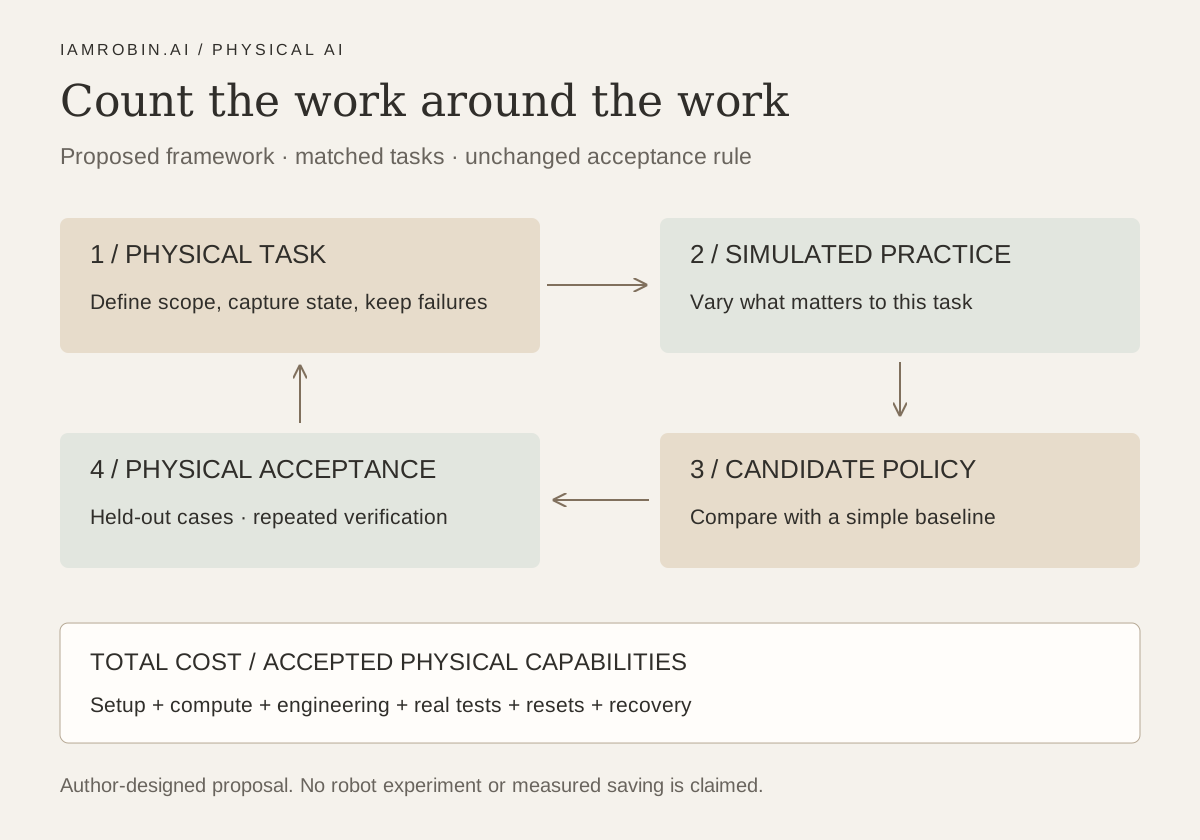
My proposed accounting unit is the total development and validation cost per accepted physical task capability. A capability needs a clear operating envelope and a repeatable acceptance rule. For example, a buyer might define a drawer-opening task for a specified set of drawers and conditions. That definition is an illustrative proposal, not a claim about an actual customer project.
Inside the numerator go setup, compute, asset preparation, engineering review, physical testing, resets and recovery. Inside the denominator go capabilities that pass the same acceptance rule. Failed attempts stay in the cost record. Counting only the attractive trials would reward the editor of the demonstration rather than the engineering system.
Suppose, purely illustratively, one method costs US$12,000 and yields three accepted capabilities. Another costs US$8,000 and yields one. The corresponding figures are US$4,000 and US$8,000 per accepted capability. The smaller bill is twice as expensive on that measure. These are invented teaching numbers, with no connection to vendor prices or measured robot results.
Even that calculation is incomplete when the capabilities differ in value. Opening three easy drawers is not equivalent to mastering one task that removes a persistent production bottleneck. Start with matched tasks and acceptance conditions before comparing the ratio. Then show where the result stops applying. A useful measure should make judgment more visible, rather than pretend judgment has disappeared.
Time deserves its own column. A cheaper method that takes much longer may postpone revenue or miss a deployment window. A faster method may consume scarce engineering attention. Reporting cash, elapsed time and human hours separately helps a buyer see the tradeoff before compressing everything into a preferred number.
The ownership question behind the bill
Who captures the saving if a simulated world becomes reusable? The robot maker may integrate it into the product. A model provider may charge for access. A systems integrator may package it with deployment work. The customer may keep some benefit through lower operating costs. These are possible business arrangements, not disclosed terms of the AMD transaction.
The distribution of value depends partly on what remains useful after the first project. If every installation needs extensive reconstruction, the business may behave more like specialized engineering. If a validated environment can support further tasks with modest additional work, recurring software economics become more plausible. That distinction requires customer and cost evidence over time.
Reuse also has limits. A digital environment can be shared while the acceptance obligation remains local. A warehouse operator still needs confidence about its own aisles, objects and procedures. The attractive idea of a common library should therefore be tested against the cost of adapting and validating it for the next site.
For a compute supplier, owning research might create insight into future demand while increasing the burden of integration. For a customer, a tightly integrated stack might reduce setup effort while raising switching costs. Both possibilities can be true. The evidence to watch is what developers can build, verify and move, followed by what they pay to keep doing it.
I would resist treating every world-model financing as evidence for the same business model. A creative tool, a simulation service and a robot policy supplier can have different users, revenue drivers and failure costs. Their common vocabulary is useful for discovery. It is insufficient for valuation.
A small test worth specifying
Before committing to a broad platform claim, I would write a bounded comparison for one repeatable physical task. This is a proposed specification only; no robot experiment, paid model call or production change has been performed for this article. It is intended to make the next evidence request concrete.
First define the task, permitted operating range and observable success condition. Freeze a set of evaluation cases that will remain outside development. Record which failures require a person to intervene. Use the same equipment and acceptance rule for the baseline and candidate, so a changed gripper or easier task cannot quietly explain the improvement.
Compare a simple existing method with the simulation-assisted method under an explicit development budget. Log preparation time, compute, engineering hours, hardware trials and recovery work. Keep an untouched copy of the original specification. If the team learns that a condition is unreasonable, revise it visibly and report the effect on both approaches.
Run repeated evaluations across the selected conditions and preserve failures alongside successes. Where the simulator ranks candidate policies, compare that ranking with the physical results. The test should be able to reveal that a visually impressive simulator is an unreliable selector. That would be useful information, even if it disappoints the sales deck.
Before looking at the outcome, state what would justify further work: a meaningful reduction in total cost or intervention burden, without weakening the accepted result. The size of that improvement should be chosen for the actual business, not borrowed from an unrelated benchmark. Uncertain results should lead to a narrower claim or another bounded test.
What would change my mind
I would become more confident when independent users show that the method reduces the full cost of achieving specified physical capabilities across repeated cases. Clear reports of human intervention, failed transfers, adaptation costs and renewal decisions would help explain whether the improvement survives ordinary operation. A large collection of generated worlds alone would leave the central question open.
I would become more cautious if the workflow repeatedly requires bespoke rebuilding, if evaluation predicts the wrong policies, or if savings disappear once setup and recovery are counted. Those outcomes would narrow the commercially useful scope. They would also help identify a better product boundary, which can be a constructive result for the builder.
For the acquisition, watch completion and integration disclosures separately from product evidence. For the technology, watch transfer and total workload economics. For the customer, watch whether the next deployment becomes easier to accept. These are three linked records, with three different clocks.
The drawer is a deliberately small example. That is its advantage. Before trying to price a simulated world, find one real task whose practice bill can be understood. A credible saving there gives the next claim somewhere solid to stand.
Categories and keywords
Categories: Physical AI; AI Infrastructure; Capital Allocation.
Keywords: world models, simulation transfer, accepted task capability, total development cost, human intervention, AMD, World Labs.
Hashtags: #PhysicalAI #WorldModels #AIInfrastructure #CapitalAllocation #IAmRobin