01 · AI Circularity Ledger
The Humanoid Evidence Ledger

A commercial loop with a scoreboard.
The conclusion for capital allocation is straightforward: a robot earns its place in an investment thesis when a customer accepts useful work at a defensible cost. The delivery truck is an earlier milestone. Confusing the two makes an immature market look measurable long before its economics can be compared.
The September 21 Reuters report puts 2025 global humanoid sales for industrial and professional use at roughly 7,000, excluding consumer and military machines. Research purchases sit inside that professional denominator. The number measures a market for equipment; it does not count productive workers. The Reuters text was checked through its UOL syndication.
My proposed investment checkpoint is paid, accepted output with the human assistance and full cost visible. The public evidence is already useful enough to build that ledger. It is incomplete enough that we should resist filling its blank cells with forecasts.
Four steps between a sale and useful labor
The evidence ladder has four rungs: equipment sold, customer acceptance, productive operation, and unit economics. Each answers a different question. A purchase confirms somebody wanted the machine. Acceptance confirms a defined task met a customer’s test. Operational records show what happened repeatedly. Economics establish what the accepted work cost and who paid.
A research laboratory can be a valuable paying customer at the first rung. Its purchase can fund development and create training data. It still tells us little about replacing a warehouse task. A commercial pilot can deliver real work while losing money for either party. A repeat order may improve the evidence without proving that every installation shares the same economics.
This framework is my synthesis, not an IFR rating system. IFR’s humanoid position paper provides category context; it does not certify individual deployment returns. Keeping those roles separate lets us use industry statistics without asking them to answer questions they were never designed to settle.
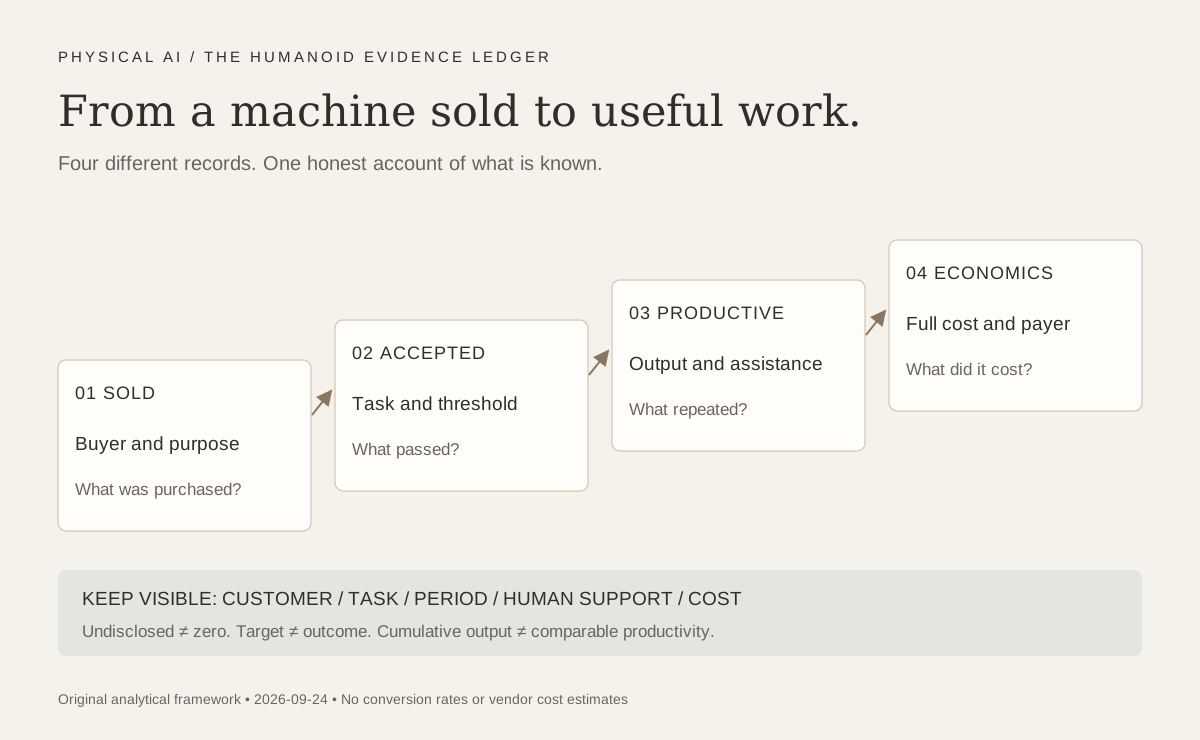
The diagram shows questions to resolve, not conversion percentages or a forecast. Movement to another rung requires another record. No arrow implies that every robot sold will reach the last box.
Start with the customer’s task
BMW’s August 2024 announcement described a several-week Figure 02 trial inserting sheet-metal parts into fixtures. That establishes a specific task and a customer-observed trial, rather than general factory autonomy. The distinction is the useful starting point. BMW trial announcement
Create one row for one deployment episode. Identify the customer, site, robot generation, task, observation period and source date. Keep an initial trial and a later rollout linked, while giving each its own observation window. Otherwise, counting announcements can turn one evolving installation into several apparent customers.
The acceptance condition should describe output that the next process can use. A lifted component is an intermediate motion. A correctly positioned component accepted by the downstream process is a business event. A rejected component, a damaged container or a late handoff belongs in the same record, because the customer has to absorb the consequence.
Define the alternative at the same time. The comparison might be a person performing one task, a fixed robot, a conveyor adjustment or a redesigned workstation. Comparing a complete humanoid system with a human wage alone silently gives the machine free integration and gives the human all the overhead. A useful procurement question compares two ways to deliver the same accepted output.
Operating disclosures are progress with boundaries
BMW’s February 2026 account reports more than 90,000 components moved in around 1,250 operating hours at Spartanburg. This is customer-side evidence of productive activity. It does not disclose a complete cost account or a fleet-wide intervention distribution. BMW production account
Figure’s November 2025 account identifies cycle time, placement accuracy and interventions as its three operational measures. Its stated thresholds are requirements or goals; they must not become observed results by paraphrase. In particular, a zero-intervention goal is not a published zero-intervention history. Figure deployment account
For the ledger, preserve these statements in separate columns: observed cumulative output, stated acceptance threshold, and missing operating distribution. Do not divide headline totals into an apparently precise productivity rate unless the population and time bases match. Rounded hours, cumulative parts and unspecified fleet exposure do not support an exact per-robot comparison.
I would ask for the distribution across shifts rather than one average. The worst routine shift matters to a customer who must keep the line moving. A successful demonstration can tolerate a specialist standing nearby; a repeatable installation needs a credible answer when that specialist is elsewhere. The relevant follow-up is a dated operating record, with exceptions retained, across a declared task and shift window.
Commercial structure belongs beside performance
GXO announced a multi-year Robots-as-a-Service agreement with Agility in June 2024, following a pilot. The disclosed workflow moves totes within an existing logistics environment. This establishes commercial structure and task context. The announcement does not give an independently reproducible customer cost per accepted tote. GXO agreement
Agility later reported that Digit had moved more than 100,000 totes at GXO’s Flowery Branch facility. Treat that as supplier-reported cumulative throughput, with the announcement’s own scope. It is valuable evidence of repeated work, while the underlying margin and assistance logs remain undisclosed in that page. Agility throughput report
RaaS changes which questions belong to the customer and which belong to the supplier. The customer needs the service fee, retained supervision, installation disruption and the accepted output it receives. The supplier needs the asset purchase, financing, maintenance, service staffing and residual value. A good customer result can coexist with a supplier subsidy. Both sides deserve separate rows.
Record who bears downtime, replacement parts, software upgrades and failed acceptance. An attractive subscription price may include support, or it may exclude costly site work. The public label RaaS cannot settle those allocations. Until the contract or reliable disclosure answers them, the cells remain UNKNOWN. The label tells us the commercial form; the contract determines how risk moves.
Count the human assistance that keeps the machine useful
Intervention counts need a definition. A pause, a remote reset, a teleoperated recovery, a maintenance visit and continuous supervision have different implications. Combine them carelessly and the figure becomes impossible to interpret. Keep event counts, person-minutes and robot downtime as separate measures, each with the same observation period.
An operator supporting several robots creates an allocation problem. Charging every robot the operator’s full shift double-counts labor. Charging none of them because the operator was already employed makes assistance disappear. Allocate recorded person-time consistently, and disclose the treatment of standby coverage. If simultaneous failures require another operator, an average utilization assumption can understate the staffing needed to recover.
Training demonstrations also need a separate ledger from production assistance. Human demonstrations can be a legitimate development input. Their existence does not show that every production cycle is remotely operated, and a claim of autonomous production does not erase development expense. Record the boundary so that useful learning does not become an argument about two different activities.
Safety should remain a release condition rather than a discount in a spreadsheet. Define the authorized task, operating area, escalation and incident reporting before judging the economics. An undisclosed incident history is UNKNOWN, not a count of zero. Commercial pressure should not reward a team for reporting fewer near misses. Better reporting may initially look worse while making deployment more trustworthy.
Put an honest denominator under cost
Use two complementary measures. Accepted units per scheduled hour captures delivered output. Total cost per accepted unit captures economics. Accepted productive hours can help compare shift coverage, provided the definition identifies what counts as productive and excludes time that merely keeps the robot powered on.
The cost numerator should follow the perspective being assessed. For an owner, include annualized equipment and integration, financing where applicable, maintenance, energy, software, insurance and human support. For a service customer, use its fee and retained costs. Do not charge both a full service fee and the supplier’s capital cost to the same customer calculation unless the contract genuinely passes both through.
An illustrative example makes the sensitivity visible. Assume, solely for a worksheet, annual total cost of $60,000 and 3,000 accepted productive hours. The result is $20 per accepted hour. If accepted hours fall to 1,500 while cost stays unchanged, the result becomes $40. These are invented scenario inputs, not prices, operating records or estimates for Figure, Agility, BMW or GXO.
| Illustrative scenario | Annual total cost | Accepted productive hours | Cost per accepted hour |
|---|---|---|---|
| Reference worksheet | $60,000 | 3,000 | $20 |
| Half the accepted hours | $60,000 | 1,500 | $40 |
This small calculation gives utilization a visible economic consequence. It does not establish a robot’s competitiveness against a worker. That comparison still needs matched task quality, labor arrangements, throughput constraints and the cost of the alternative. If a missing input dominates the decision, request that input before adding decimal places to the model.
Compare deployments before comparing countries
A US–China league table needs equivalent populations. Hardware origin, customer location, installed units and productive hours describe different dimensions. A manufacturer can ship globally; a domestic research purchase can support future capability; an overseas pilot can reveal a narrow task. None is a substitute for the others.
For a defensible comparison, fix the task, payload, acceptance threshold, shift length, human assistance, safety conditions and cost perspective. Then record the observation date and source quality. A customer-confirmed record and a supplier demonstration should remain visibly different even when both are interesting. The ledger should reward disclosure without pretending that silence proves poor performance.
This also prevents a false geographic conclusion from an uneven public record. More accessible English-language customer accounts can make one market look better measured. More shipment announcements can make another look larger. Neither observation settles comparative productivity. The correct current status for a like-for-like national productivity ranking is UNKNOWN in this dossier.
The investment question can still advance. Ask which businesses are improving repeatability, deployment speed and the ability to serve another site without bespoke rescue work. Those are hypotheses worth investigating with evidence. They are not grounds to assign a national winner or infer a valuation multiple from a photograph of a factory floor.
The ledger that can survive the next announcement
Keep the initial public register small enough to maintain. Its unit is a customer-site-task episode, not a headline. Store the original URL, source date, observation window and retrieval date alongside every load-bearing claim. A later correction should add a new observation and explain what changed, preserving the earlier record.
| Record | What the evidence supports | What remains UNKNOWN here |
|---|---|---|
| BMW trial | Named customer and defined sheet-metal task | Full acceptance and cost record |
| BMW operating account | Reported components and operating hours | Complete interventions and unit economics |
| Figure account | Supplier description of operating goals | Full observed goal attainment distribution |
| GXO agreement | Customer-confirmed commercial structure | Contract price and accepted-unit cost |
| Agility milestone | Supplier-reported cumulative tote throughput | Comparable exposure, assistance and margin |
These are selected observations, not an exhaustive vendor ranking. Their value lies in the next request they make obvious. A customer-confirmed trial asks for acceptance results. Productive output asks for the assistance and cost behind it. A favorable cost figure asks whether a second site can reproduce it under comparable conditions.
A practical update routine is to revisit the existing rows when a named customer or supplier publishes new operating evidence. Retain the source date even when the page is retrieved later. Distinguish a replacement robot from an additional robot and a signed agreement from an installed fleet. If two accounts conflict, preserve both and mark the disputed field CONFLICTED until the denominator is reconciled.
What would change my judgment
I would advance a deployment from WATCH to deeper investigation after receiving three connected records: customer acceptance for a named task, sustained output with assistance and exceptions visible, and economics that include the costs borne by both parties. A repeat customer rollout under similar conditions would strengthen the case further. This is a proposed research threshold, not a purchase recommendation.
The smallest useful next action is to complete one matched deployment row. Request a defined observation window, scheduled and productive hours, accepted and rejected units, intervention person-minutes, downtime, safety exceptions, and the relevant cost schedule. Check each field against its source and leave unavailable numbers null. A clean row is more useful than a colorful dashboard full of estimates.
Today’s completed output is this evidence framework and its source register. No operator logs were obtained, no customer diligence was conducted privately, and no investment, procurement or deployment action was executed. The article gives a reader a reusable way to ask better questions while keeping the boundary of what is known visible.
A humanoid market can grow through research, experimentation and commercial work at the same time. The ledger lets each form of progress count for what it establishes. The next compelling story will be a customer showing accepted work, repeatability and a cost account that another customer can understand. That is when a machine begins to earn a durable place in the capital story.
Categories and keywords
Keywords: humanoid robots, Physical AI, accepted output, intervention cost, deployment evidence. Categories: Robotics, AI Infrastructure, Investment Research.
Hashtags: #HumanoidRobots #PhysicalAI #Robotics #Evidence