01 · AI Circularity Ledger
Building a Newsroom That Learns From Distribution

A commercial loop with a scoreboard.
The conclusion is simple: an AI newsroom earns its advantage when tomorrow’s editorial decision improves because of today’s distribution. Producing twenty headlines is easy. Remembering which promise attracted the right reader, whether the story kept that promise, and when the lesson stopped working is harder. That memory is the asset worth building.
For SunTV, the strategic starting point is a brand, an archive and a point of view. The proposed iSun1.news loop turns those resources into experiments: event → editorial judgment → twenty frames → controlled distribution → observed response → retained learning. This article specifies that loop. It does not announce a proven audience-growth engine, completed rights audit or winning experiment. Those outcomes remain UNKNOWN until their evidence exists.
1. A newsroom needs a memory of decisions
Imagine an editor receiving a story about a new robot. One headline leads with the machine. Another leads with the worker whose job changes. A third asks who finances the factory. All three may be accurate, yet they make different promises to different readers. Calling one headline the winner without recording its audience and distribution conditions throws away most of the lesson.
A useful editorial record therefore begins before publication. What changed in the world? Which fact carries the story? What would a reader expect after seeing this opening? What evidence pays off that expectation? The editor should be able to answer without looking at a click counter. A compelling frame earns consideration; its factual foundation earns permission to publish.
The durable unit is a decision receipt connecting the event, evidence, chosen frame, audience, channel, observation window and result. Store the rejected alternatives too. They reveal what was considered and prevent the next editor from mistaking an old idea for a new discovery. A newsroom that retains only published URLs has an archive. A newsroom that retains the choices around those URLs can begin to learn.
2. Three references illuminate different parts of the loop
The published X recommendation repository describes components for user signals, candidate sourcing, ranking and filtering. It distinguishes explicit actions from implicit behavior. The useful lesson is architectural: selection and observed response belong in a connected system. The repository does not establish the exact current production recipe or a transferable formula for SunTV.
Monolith’s 2022 paper describes online learning for changing recommendation workloads. Its repository is now archived, so it is a historical design reference rather than a maintained newsroom kit. Feedback speed is valuable only when the feedback deserves to change the system.
News Minimalist’s account of its method provides a different reference: a news product can organize selection around assessed significance. That is a disclosed editorial method, not independent proof of objective importance. Together, these references suggest three separate questions: what matters, who might care, and what the response can teach. Our proposed workflow below is an original synthesis, not a claim that any source operates this complete design.
3. SunTV supplies a starting advantage to test
SunTV’s public website presents interviews, international business connections and brand authorization. Those are useful starting materials for a newsroom with an identifiable voice. The larger proposition is that recognizable people, original stories and repeated editorial judgment can attract contributors and audiences around a common center.
Call that center a gravity field. It is a strategy, not a measured network effect. A familiar brand may open a door; the next story still has to deserve the reader’s time. An old interview may contain an overlooked insight; its existence does not establish permission for every new language, platform, excerpt or commercial use. Catalog access, clearance and audience response separately.
The first archive exercise should be small: choose one genuinely reusable item, document its provenance and permitted uses, and connect it to one current question. If those conditions cannot be confirmed, use a cleared original event packet instead. The newsroom should learn from usable material before expanding its inventory. Archive size is a poor substitute for a rights-cleared story that readers return to.
4. Freeze the facts and let the framing move
Every event needs a stable fact packet. Record the actor, event date, original evidence, material numbers, quotations, uncertainty and rights status. A later source correction creates a new version with an explanation. It must never disappear into a quietly rewritten headline experiment. Otherwise the system cannot tell whether a response changed because of framing or because the underlying claim changed.
The mutable layer contains the opening, narrative order, analogy, image treatment and audience question. Each candidate should point back to the claims it uses. A surprising title is acceptable when the surprise survives inspection. A question mark does not rescue a false premise. A simulated outcome must remain a simulation in the opening that creates the reader’s expectation.
This separation also makes review cheaper. The editor can approve the shared evidence once, then compare twenty interpretations against that fixed reference. If a candidate introduces a new number, motive or accusation, it returns to evidence review. The experiment can explore style widely while keeping the meaning of the event stable. Creative variation becomes inspectable instead of becoming an excuse for factual drift.
5. Twenty frames are a search space
Twenty candidates should represent different questions, not twenty synonyms for the same headline. An editor might explore consequences for workers, a capital constraint, an unexpected historical parallel, a neglected customer, a technical bottleneck or a contradiction between promise and delivery. The test is whether each frame changes the reader’s reason to care while preserving the event.
After generating the pool, select two frames with a clear contrast. Hold the article’s substantive payoff constant. Record why those two deserve comparison and which audience could distinguish them. Keep the other eighteen as candidates, not as scheduled posts. Flooding every channel with near-duplicates would make the experiment harder to interpret and could exhaust the audience before it produces learning.
The proposed first run therefore has two stages. Offline, reject unsupported, repetitive or misleading frames. In an authorized distribution setting, compare a small reviewed pair. A strong offline editorial score only qualifies a frame for observation. It is neither a forecast of audience lift nor evidence that a headline should become the default. The audience gets the final say on response; the newsroom keeps responsibility for truth.
6. Attention moves through several different commitments
The attention ladder is a proposed measurement model: exposure → click → meaningful reading → return → voluntary relationship → useful participation or transaction. Each rung asks more of the reader. The model should keep those commitments distinct rather than adding them into a large number called engagement.
An impression means a story had an opportunity to be seen under a declared measurement rule. A click indicates interest in the promise. Reading behavior may indicate attention, though a timer cannot establish comprehension. Return suggests continuing relevance when the observation window is mature. A voluntary subscription or contribution creates a more direct relationship. A transaction has its own commercial and consent conditions.
The arrows are hypotheses, not automatic conversions. A widely seen story may recruit few returning readers. A small specialist story may attract one valuable source. Missing measurements stay UNKNOWN; they never become a zero-conversion verdict. For the first experiment, choose one primary outcome and a small set of guardrails. Otherwise the editor can always find some metric that makes a preferred headline appear successful.
7. Compare promises under comparable conditions
Distribution introduces confounders immediately. A morning post and an evening post can reach different people. A familiar account and a new account start with different relationships. A platform may show one variant much more often. These differences belong in the receipt, because an observed gap cannot automatically be attributed to the headline.
Where assignment can be controlled, define the comparison in advance and keep the shared article, cover and eligible audience consistent. Where a platform controls exposure, label the result observational. Retain impressions and relevant denominators alongside counts. Do not compare a percentage built from a handful of readers with one built from a much larger mature cohort as though their precision were equal.
Declare a review window and a minimum evidence requirement before looking for a winner. If volume is insufficient, record insufficient evidence and continue the bounded observation if authorized. A small cohort may still supply useful qualitative clues, but those clues should become the next hypothesis. They should not be promoted into a general claim about what an entire audience wants.
8. Retain conditional lessons instead of slogans
The memory entry should read like a usable instruction with conditions. For this audience, on this channel, during this window, a specific promise attracted a specific response, with these caveats. Record the evidence, counterexamples and review date. “People love robots” is too broad to guide the next assignment. “This framing deserves another controlled test” can be precise and honest.
Separate three kinds of memory. Event memory preserves what happened and what was verified. Editorial memory preserves the frame, its promise and the evidence that pays it off. Audience memory preserves aggregate observations under declared measurement conditions. The third should never become a private dossier of inferred identities or sensitive interests. Useful learning does not require knowing everything about a reader.
Every retained lesson needs a route to retirement. A platform changes, a subject becomes familiar, or a better test contradicts the earlier result. Mark the old lesson superseded while retaining its receipt. The newsroom should be able to explain why its current policy changed. Otherwise memory becomes a growing collection of anecdotes that quietly hardens into dogma.
9. Keep trust inside the objective
An attention-maximizing system can find shortcuts that an editor would regret. The practical response is to specify what disqualifies a frame before measurement: unsupported claims, concealed uncertainty, misleading imagery, rights problems or a promise the article cannot fulfill. These are release conditions. A high response rate cannot compensate for breaking them.
After publication, corrections, disappointed-reader feedback and source challenges belong beside positive response. A headline that wins clicks while creating a correction burden has imposed a cost. Track that cost separately, along with editorial review time and production expense. This keeps the economic argument anchored in accepted work rather than cheap drafts or a growing pile of impressions.
SunTV’s proposed role is to provide continuity across experiments: recognizable judgment, clear sourcing and responsibility for corrections. Different small teams or one-person companies could work within that field, but their reproduction is a possibility to test. A mushroom metaphor is helpful only if each new organism inherits a sound fact packet, a bounded permission set and a way to learn from reality.
10. The first experiment must fit on one page
Start with one cleared event packet and twenty distinct frames. Select two, document the factual promise and the audience hypothesis, and freeze the shared article. Designate an editor who can reject either version before distribution. List the permitted channels and keep any posting outside existing authority as a prepared draft. Publication of this essay does not authorize a separate social experiment.
The one-page receipt should contain the event identifier, source versions, rights decision, frame identifiers, assignment method, observation window, primary outcome, denominators, trust guardrails and review owner. Production cost includes generation, retries, editing and verification. If a proposed model routing scheme is evaluated separately, measure cost per accepted result and human interruption; cheap tokens alone do not establish operational improvement.
At review, choose one of three outcomes: retain a narrow lesson, design another bounded test, or record no useful learning. Each is a legitimate result. The next article should be able to cite the retained lesson that influenced it. If no subsequent decision changes, the newsroom has collected analytics without demonstrating that it learned.
No audience-lift figure, completed archive-rights audit or winning iSun1.news variant is established by this article. Its completed output is the design and evidence framework. The experiment is READY as a specification; observed performance remains UNKNOWN. The next meaningful milestone is a reviewable receipt from authorized distribution, followed by a documented editorial decision that uses it.
11. The loop is the product
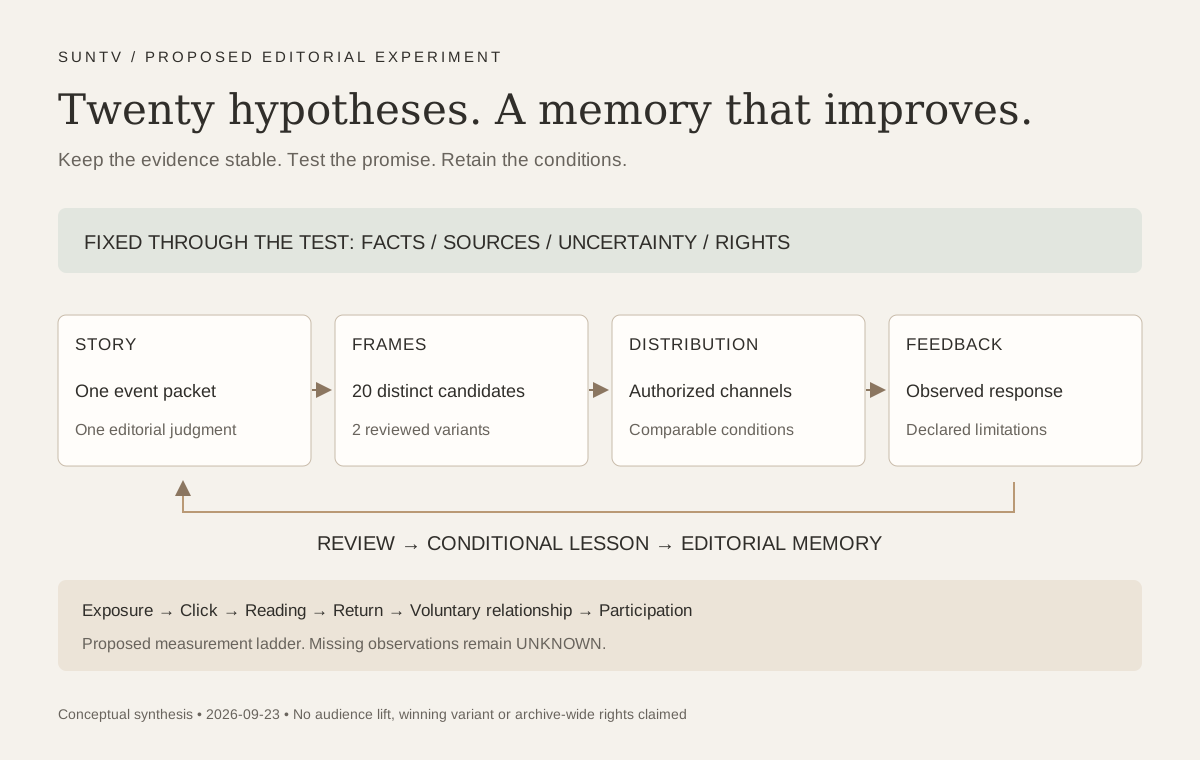
The diagram is a conceptual workflow, not a performance chart. Facts and rights remain fixed through an experiment. Framing can change. Distribution supplies observations whose limitations travel with them. Only a reviewed, conditional lesson returns to editorial memory. This is the boundary between adapting to readers and merely chasing the last spike.
A newsroom used to publish one headline. An AI newsroom can examine twenty hypotheses, choose a responsible pair and remember what the result actually established. Attention is the invitation. Trust makes a return possible. Retained learning gives the next story a better starting point. The investment case begins when that better starting point produces evidence of repeated value.
Categories and keywords
Categories: AI systems; Media strategy; Editorial experimentation.
Keywords: SunTV; iSun1.news; framing; recommendation systems; retained learning; audience trust; rights provenance.
Hashtags: #AI #Media #SunTV #EditorialStrategy #LearningSystems