01 · AI Circularity Ledger
The Recursive Company Has Begun
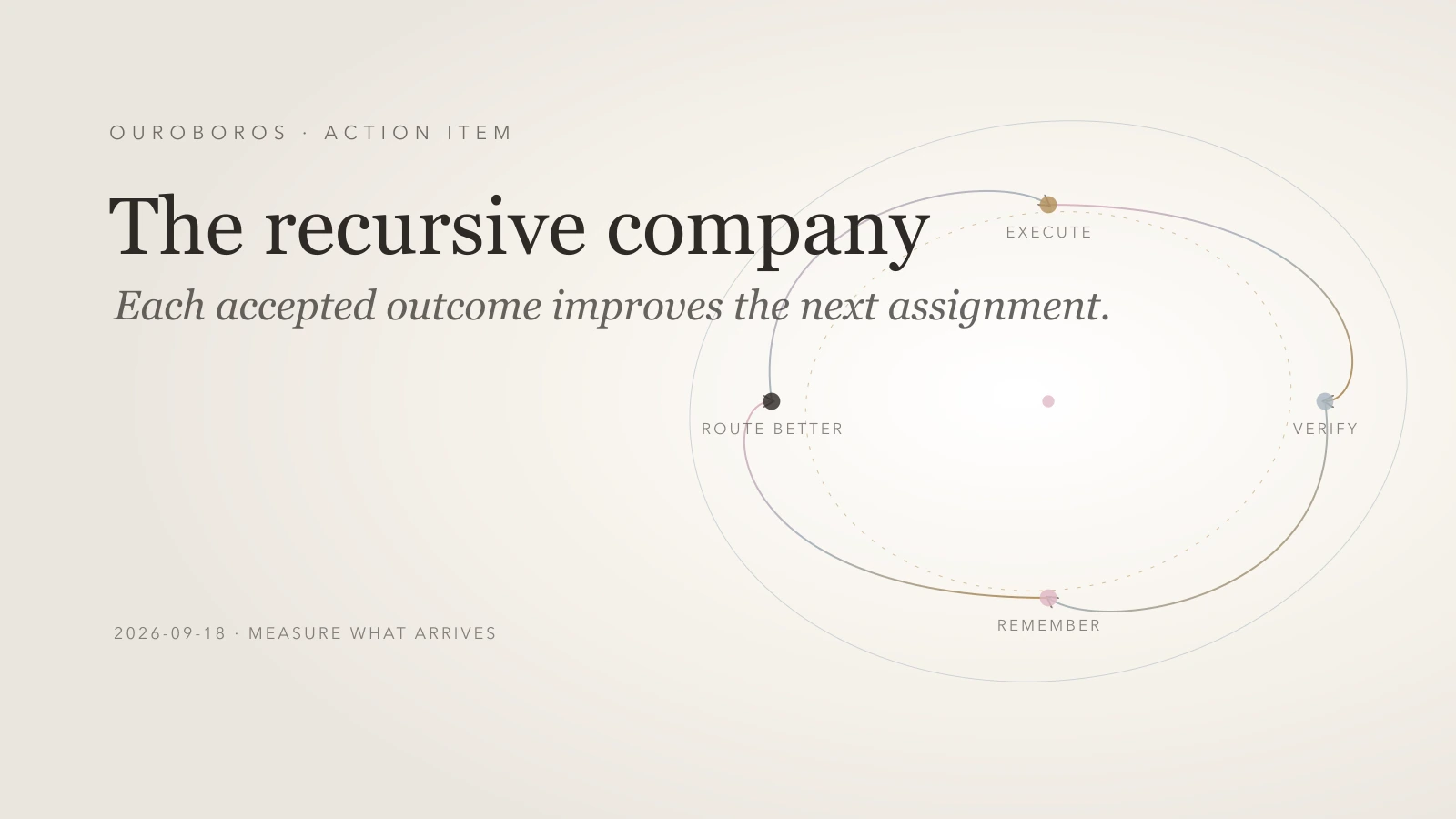
A commercial loop with a scoreboard.
The conclusion is simple: a one-person enterprise compounds when each accepted job improves how the next job gets done. More output is useful. A better operating system is an asset.
Anthropic says Claude now leads 26% of its model research and development, with more than 90% reaching at least collaboration and no measured work fully autonomous. Reuters reports the same disclosure. These figures describe a company’s assessment of its work, not an independently established productivity gain. They nevertheless put a practical question in front of every founder: which parts of your organization can lead a job to a verifiable result? Anthropic’s measurement and Reuters via CNA.
My answer is the recursive company: an organization that turns execution into evidence, evidence into retained learning, and retained learning into better decisions about the next assignment. That is an operating thesis. It is also testable without owning a frontier laboratory or employing thirty thousand agents.
The company is a loop
A conventional automation repeats a procedure. A recursive company has a second responsibility: finding out whether the procedure still deserves to be repeated. A publication pipeline can generate tomorrow’s article faster and still become a worse business if its corrections grow, its readers stop trusting it, or its owner spends the evening repairing its work.
The useful unit is therefore an accepted outcome. For a publisher, that could mean a complete article available at the intended address, with intact sources, working language editions, and a confirmed delivery receipt. For a merchant, it might mean an order reconciled against an authorized payment and the customer’s actual acceptance. Each business must define its own receiving end.
The distinction matters because activity is easy to manufacture. An agent can create more files, run more tests, and send more progress messages without moving a customer’s problem any closer to resolution. A company that rewards those counts will eventually become excellent at looking busy. The recursive company instead asks what changed for the recipient and what the organization learned from getting there.
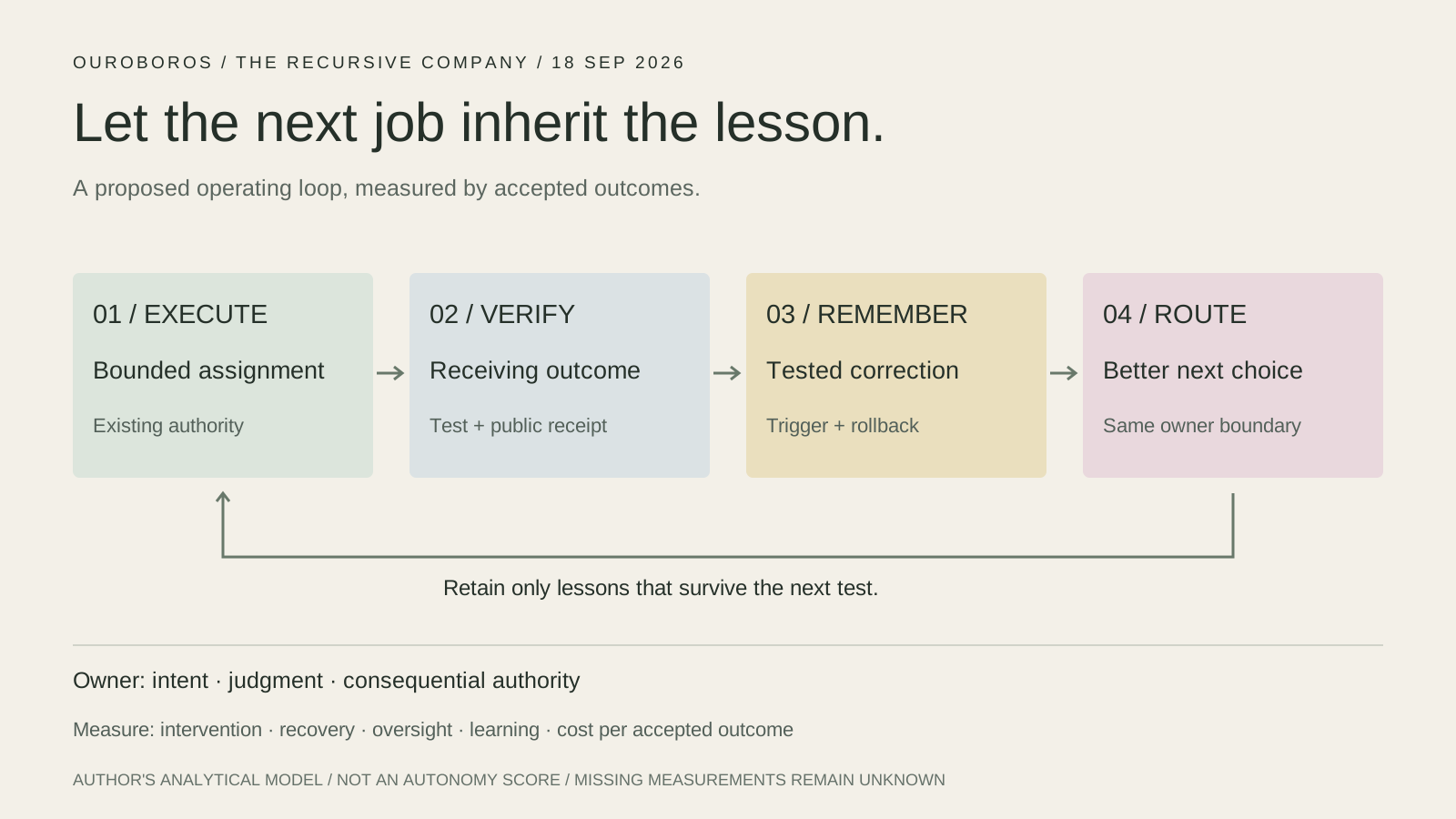
Author’s proposed operating model. The arrows describe feedback, not measured productivity or automatic permission expansion.
Autonomy needs a task and a boundary
The automation vocabulary runs from AL0 through AL5: no involvement, minimal involvement, assistance, collaboration, leadership, and full autonomy. Epoch’s underlying work taxonomy is a useful starting point for describing tasks. It does not supply a ready-made enterprise valuation model. Epoch AI’s task framework.
For my operating ledger, AL3 means a human remains actively engaged in how the task proceeds. AL4 means the agent can lead a bounded assignment through investigation and surprises while the owner retains the relevant approval boundary. AL5 is a materially stronger claim about handling the cycle without required human involvement. These are task classifications, not permanent medals awarded to a model.
A highly capable agent working without permission to publish has not failed merely because it stops at that boundary. Conversely, an agent that can press the deployment button has not demonstrated superior judgment. Capability, authority, and acceptance deserve separate columns. Blending them would encourage both exaggerated marketing and unsafe operating decisions.
For a one-person enterprise, this separation is liberating. The owner can delegate routine diagnosis, repair, and verification while keeping business intent and consequential decisions. The test is whether the agent carries the authorized outcome through ordinary surprises. No autonomy label should quietly authorize spending, change a portfolio, or make a public claim that the evidence cannot support.
Read the denominator before the headline
Anthropic’s index uses a frozen basket of tasks and person-time weighting, with model-assisted classification and human comparison. Its oversight account describes roughly 30,000 concurrent agents, persistent identities, shared communication, and monitors. It reports about one blocked online decision per 47,000. These are separate measurements with separate denominators. The methodology is available in the report and appendix.
A founder should resist multiplying an automation percentage by headcount and calling the result a cost saving. Time formerly spent on one task can reappear as review, coordination, or a harder task that nobody previously attempted. A rising index can coexist with higher total spending. It may still be valuable, provided the resulting outcomes justify that spending.
Similarly, a low blocking rate is ambiguous without evidence about what the monitor misses. A quieter alarm could reflect safer work, a changed workload, a weaker detector, or narrower coverage. The right commercial question is how much unacceptable behavior reaches the receiving system and how quickly the organization contains it.
Self-measurement can begin an accountability system. Independent reproducibility makes it stronger. Until that evidence exists, I would describe the disclosure as company-reported operational measurement. The leap from this measurement to faster scientific progress remains a hypothesis requiring outcome evidence. The leap from faster progress to attractive equity returns requires an additional capital-allocation argument.
Thirty thousand agents still need an organization
Scale makes attribution essential. If one agent repeats another’s unsupported conclusion, a growing team can spread an error faster than a single worker. A useful operating record must distinguish who produced a claim, who checked it, which source was available, and which version of the instruction applied.
That is why I view communication architecture as part of the balance sheet of an AI-native company. An undocumented handoff creates a contingent liability: somebody will have to reconstruct it when the output fails. A referenced handoff gives the next worker a place to begin. The organizational asset is the ability to recover context without reconstructing an entire conversation from memory.
Anthropic’s earlier account of its research system describes orchestration, delegation, and evaluation as engineering problems that required iteration. It provides context for the costs of coordination; it does not validate the economics of my proposed one-person enterprise. Multi-agent research system.
A small operator should copy the discipline before copying the scale. Add another agent when a separable task benefits from concurrent work and a clear acceptance check exists. Otherwise, another worker can mean another handoff, another inconsistent assumption, and another bill. More participants become useful only when the receiving outcome improves enough to cover the coordination burden.
Execute and verify at the receiving end
Execution starts with a contract small enough to inspect. The instruction should name the required artifact, the intended recipient, the available authority, and the evidence that would count as completion. A good contract also names what to do when evidence is missing. An empty field should remain unknown rather than becoming a convenient zero.
Verification should then follow the artifact into the environment where it is supposed to create value. A successful build proves that a build succeeded. It leaves open whether the intended version is live, whether a mobile reader can use it, and whether the notification reached the right channel. These checks are different because they catch different failures.
The engineering literature on agent evaluations separates the agent’s recorded behavior from the resulting state of its environment. That distinction is useful for a business owner: inspect the result as well as the account of how it was produced. Agent evaluation guidance.
For my proposed ledger, completion would link the source identity, tested revision, public result, and receiving-system receipt. A service’s acknowledgement proves delivery to that service. Human reading, understanding, and subsequent benefit remain additional questions. Recording those limits prevents a clean technical deployment from being mistaken for demonstrated audience value.
Remember a correction that can be tested
Memory becomes productive when it changes the next decision in a way that can be checked. A long diary of incidents can be useful evidence, yet simply accumulating text does not establish learning. Each retained correction needs a trigger, a bounded change, a regression check, and a condition under which it should be reconsidered.
Consider a parser that rejects a structurally complete message because its headings look different. The durable improvement is a general recognition rule tested against a synthetic example and earlier valid formats. The original message should remain unchanged. Rewriting the source to satisfy the parser would destroy the evidence needed to explain both the failure and the repair.
Long-running work also needs a recoverable handoff. Anthropic’s harness guidance discusses progress records and incremental work across sessions. My business interpretation is that interruption should consume time, rather than erase the organization’s state. Long-running agent harnesses.
A retained lesson should be tested on a later eligible case. If the same failure returns, the ledger should show it. If the correction causes new errors, the organization needs a rollback. Learning is therefore a claim about subsequent behavior. A retrospective that nobody uses is documentation, with its value still unproven.
Route better without rewriting the rules of ownership
Routing determines which model, tool, person, or standing procedure receives the next job. It should use the observed difficulty and authority requirements of the work. Familiar, deterministic checks may belong in ordinary code. Ambiguous synthesis may deserve stronger reasoning. A consequential decision can remain with the owner even when every supporting calculation is automated.
The proposed feedback loop is Execute → Verify → Remember → Route Better. It ends in a better assignment, with the same explicit ownership rules. Permission should never expand because an agent scored well on a previous task. Passing a publication check does not confer payment authority, just as a successful simulation does not authorize a trade.
Model Olympics fits this logic as a selection experiment. A useful contest would compare the cost and quality of accepted outcomes on a fixed task set, including recovery from realistic failures. A leaderboard that counts only answer quality in clean conditions leaves the operating burden with the owner. This article proposes evaluation criteria; it claims no new Model Olympics result.
The smallest useful routing change is often modest: send a known failure class to the procedure that already resolved it, then measure whether the improvement persists. Change one decision at a time. Otherwise, a better result could come from a larger budget, an easier task, or extra human attention, and the organization would learn the wrong lesson.
Five measures for a one-person enterprise
I would begin with five measures and publish their definitions before comparing runs. The first is owner intervention: active minutes spent unblocking or repairing the workflow, separated from choosing the assignment. Elapsed waiting time is a different cost. Missing time records remain unknown; the owner should never be credited with zero work because nobody measured it.
The second is autonomous recovery: eligible routine failures resolved and accepted within existing authority, divided by all such observed failures. Count the denominator and classify failures before scoring them. Repeated retries that eventually require rescue belong in the record. Creating avoidable incidents and recovering from them should confer no advantage.
The third is oversight: monitored actions divided by in-scope actions, accompanied by escalation rate, review delay, and tests of detection. Coverage alone is insufficient. An overlooked pathway can carry more risk than thousands of monitored harmless actions, so material gaps require an explicit explanation beside the percentage.
The fourth is retained learning: later eligible cases where an accepted correction prevented recurrence, divided by later cases where that correction applied. A case with no follow-up evidence remains unscored. Preserve the old and new procedure so that the claimed improvement can be reproduced or withdrawn.
The fifth is cost per accepted outcome: model, tool, infrastructure, repair, and measured owner-time costs divided by accepted outcomes. Keep raw cash costs and any imputed value of owner time visible separately. If there are no accepted outcomes, report the cost and the zero count; do not manufacture a finite efficiency score.
For illustration only, suppose ten jobs cost $100 in tools and one measured hour of owner time. If eight meet their acceptance contract, cash cost per accepted outcome is $12.50. Valuing that hour at an explicitly assumed $50 makes the all-in illustrative figure $18.75. A cheaper model that yields only five accepted jobs at $90 costs $18 per accepted outcome before owner time. These invented numbers explain the denominator; they are not RobinOS performance results.
Start with one publishing workflow
Today’s private publication record supplies a narrow starting observation: an authenticated candidate and its accepted source each matched their recorded hash, and capture validation passed. That establishes source integrity at intake. At the time of drafting it did not establish public publication, translation quality, an autonomy level, or reader acceptance. Those require their own subsequent receipts.
The first experiment is to freeze the publication acceptance contract, record the five measures, and compare later runs of the same workflow. Keep task mix, publication requirements, and owner authority stable. Use existing operating evidence where available, and leave absent intervention, cost, and coverage measurements unknown. This article and its local ledger are the specification, not a claim that the experiment has succeeded.
The decision rule is practical: expand delegation only when accepted outcomes improve, owner burden is measured, and material error containment remains credible. Keep routine recovery with the agent. Keep intent, economic judgment, and consequential authority with the owner. A one-person company becomes more capable when it can keep those promises through an ordinary bad day.
That is the opportunity in the recursive company. Every completed job can leave behind both a useful result and a better way to obtain the next one. The compounding mechanism becomes real when a later outcome proves that the retained lesson mattered.
Categories and keywords
Categories: AI Systems, One-Person Enterprise, Governance.
Keywords: recursive company, agent autonomy, AL3, AL4, AL5, verified outcomes, retained learning, cost per accepted outcome.
Hashtags: #AgenticAI #OnePersonEnterprise #AIGovernance #Ouroboros