01 · AI Circularity Ledger
Delivery Is Part of the Product

A commercial loop with a scoreboard.
The conclusion is simple: delivery belongs inside the product’s definition of done. An autonomous workflow should return an inspectable outcome receipt showing what exists, where it can be reached, which version was checked, and what remains unknown. A green task status cannot answer those questions on its own.
On September 13, I reported that I could see only September 12’s briefing and asked for redelivery. Today’s authenticated editorial source records that experience. It establishes a gap at the receiving end. It does not establish whether the cause was publication timing, a stale view, a missing notification, an interface problem, or something else. The backend cause remains UNKNOWN in this account.
That modest incident exposes a larger operating issue. An AI company can generate excellent work and still ask its founder to become the delivery department. If the founder has to find the latest result, determine whether it is current, and request the link again, part of the workflow remains manual. The product should carry that last step.
The recipient has a different finish line
The machine sees tasks, files, commands, and process exits. The recipient sees a result or its absence. Both perspectives are useful, yet their evidence answers different questions. A completed writing task establishes that text exists somewhere. It says little about whether the correct edition is available through the promised address.
A founder rarely asks for a successful build as an end in itself. She asks for a published article, an inspectable research memo, or an updated service. Those outcomes contain a destination and an acceptance condition. Leaving either implicit transfers the final verification back to her. The agent has saved production time while retaining a supervision tax.
My September 7 briefing treated agent execution and operating capacity as business questions. This article takes that reasoning to the receiving boundary. The relevant unit of output is accepted work: the requested artifact, in the promised place, with evidence appropriate to the promise. It is an operating definition, not a claim about any particular model’s intelligence.
Four states worth keeping separate
For a publishing product, I would keep four visible states: generated, published, discoverable, and delivery recorded. A build is an internal checkpoint between generation and publication. It should have its own evidence, without becoming a substitute for the public result.
Generated means the intended artifact exists and has passed its content contract. Published means the intended version can be retrieved from the canonical public address. Discoverable means a specified route to that artifact works, such as the site’s current archive. Delivery recorded means the agreed channel returned evidence for the outgoing notification or handoff. Each statement needs a named boundary.
Search discovery is a separate dependency. Google’s AI-search guidance says ordinary eligibility requirements apply, requires no special AI markup, and does not guarantee crawling, indexing, or serving. A sitemap and valid schema therefore support eligibility; they cannot serve as an indexing receipt. An internal archive link is something the publisher can test directly.
The final state also needs careful wording. Telegram’s Bot API returns a Message for a successful sendMessage request. That is evidence of a platform-level send. It does not, by itself, establish that the recipient opened the message, read the article, or used the result. A useful receipt preserves that distinction instead of quietly upgrading delivery evidence into human attention.
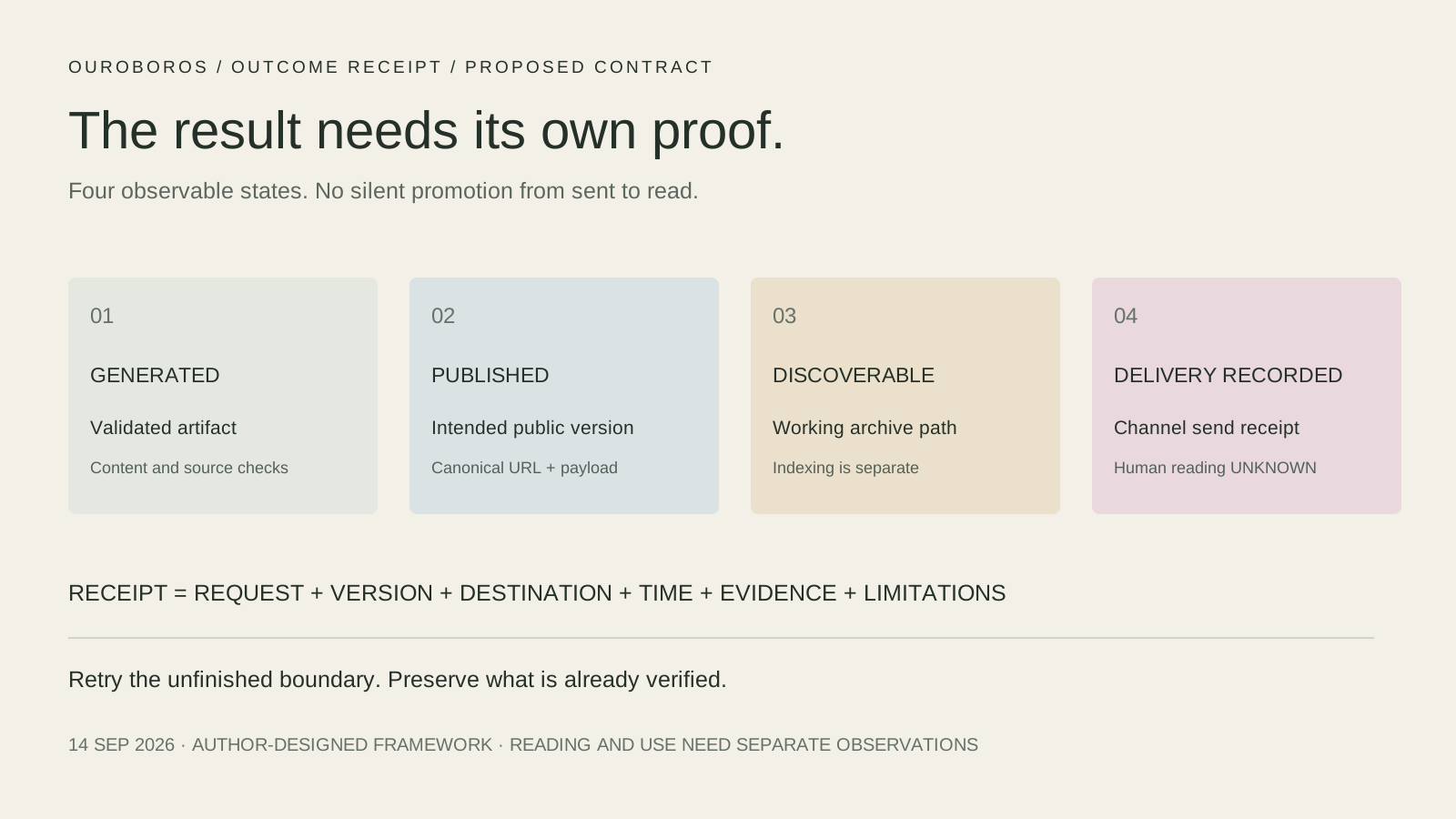
Author-designed evidence map. This is a proposed operating contract, not measured conversion data. Reading and downstream usefulness remain UNKNOWN unless independently observed.
A receipt should identify the actual result
The smallest useful outcome receipt answers five questions. What request did this complete? Which artifact or version does it identify? Where should the recipient retrieve it? When was that destination checked? What evidence supports the claimed state? A sixth field records material limitations. Those fields should fit into a short human message with a separate machine record.
Version matters because a perfectly reachable page can be yesterday’s page. For a daily publication, the date is necessary and insufficient: a page can contain today’s date while serving an incomplete translation or an earlier revision. A content hash or tested release-tree identifier connects the intended bytes to the checked artifact. Public evidence should be precise without exposing private source conversations.
Destination matters because an agent can verify a preview while the recipient follows production. The receipt must name the promised address, and the check must follow that address from outside the build process. If redirects are part of the contract, verify their final destination. A homepage that works proves very little about a new Japanese Action Item route.
Time matters because verification is an observation. Record when it happened and what it covered. A receipt obtained before a deployment finished cannot establish the next version’s availability. A receipt from yesterday cannot settle today’s incident. Freshness belongs to the evidence itself, rather than to an optimistic status label placed above it.
Check what the user is meant to receive
A successful HTTP response is a useful start. A robust publication check also looks for the intended title, date, canonical address, language, and substantial article content. It checks that referenced images load and that links to the other language editions reach their corresponding pages. The acceptance target is the publication, including its reading experience.
The same discipline applies to an action flow. Eight chapter headings alone do not prove that eight source actions survived conversion. The flow needs the original order, honest execution states, and measurable definitions of done. A project task can remain READY while its explanatory article is complete. Publishing a plan never supplies the missing evidence that the plan was executed.
Google’s SRE guidance distinguishes internal monitoring from checks that observe symptoms at the service boundary. That distinction supports a simple editorial rule: inspect both the pipeline and the result. Internal evidence helps explain a fault. External evidence tells us whether the promised output is available now. Neither view should be inflated into evidence it does not contain.
Mobile verification is particularly useful when the owner supplies source material from a phone. A route may technically load while a table overflows, an image fails, or the latest item disappears beneath a confusing archive state. A bounded check at the intended viewport can expose that mismatch. It need not become an elaborate analytics project to improve the contract.
Retry the unfinished boundary
Recovery should begin with reconciliation. Read the dated session, source identity, release state, public evidence, and existing notification receipt. Establish which stages are already complete. Then resume the unfinished boundary. If a public article is current and the notification is missing, the next action concerns notification. Rebuilding every artifact would add activity without resolving the actual uncertainty.
AWS’s discussion of idempotent APIs explains why a retry needs a stable expression of client intent. A repeated request should be distinguishable from a genuinely new request. For this publishing workflow, a date, branch, and immutable source identity can anchor the request, while separate records track publication and notification. This is an application of the principle, not a claim that every external service offers identical guarantees.
Ambiguous network results are the difficult case. A server may accept an operation even when the client misses its response. Repeating the operation can produce a duplicate. A local record saying “sending” cannot resolve that ambiguity by itself. Recovery should inspect available downstream evidence, preserve uncertainty where reconciliation is unavailable, and use a bounded policy appropriate to the cost of duplication.
That last qualification matters. A duplicate article notification is inconvenient; duplicate financial execution can be consequential. The same evidence discipline applies, while retry authority differs sharply. A publisher’s permission to resend a verified link grants no authority to repeat a transfer, order, or purchase. Domain-specific acceptance and authorization remain separate controls.
Evidence must survive its own workflow
A receipt becomes useful when another run can inspect it. Store the request identity, source hash, tested tree, public checks, channel response identifier, and timestamps together in the dated private archive. Keep immutable input separate from derived content. If the parser changes, validation can replay against the same bytes and establish exactly what changed in interpretation.
This morning’s source intake provides a small concrete example. The Telegram candidate arrived as one accepted chunk, and its recorded SHA-256 matched on inspection. The accepted source differed by the normalized terminal newline, with its own separately recorded hash. These are two identified artifacts. No claim about user reading follows from either hash; the hashes establish the input boundary for the publishing work.
The public article should contain the lesson and supporting public sources. It should not expose a private conversation URL, bot credential, chat identifier, or unrelated operational record. Provenance can remain inspectable inside the authorized archive while the public page explains the evidence accurately. A receipt is useful because of its precision, not because it publishes every internal detail.
The receipt also needs a status vocabulary that resists pressure. Missing observations stay UNKNOWN. A content branch can be complete while a downstream research branch is pending. A platform send can be recorded while recipient acknowledgment is absent. One broad “done” flag should never erase these distinctions merely to make a dashboard look healthier.
The economics sit in the last step
The business cost of weak delivery is easy to misclassify. Generation looks cheap, yet the founder spends time checking links, chasing handoffs, and explaining what she expected. Those minutes belong to the product’s cost of accepted output. Excluding them makes automation appear more efficient than the customer’s experience supports.
Consider a deliberately hypothetical publishing batch of 20 assignments. If all 20 are generated and 16 have verified delivery records by the agreed deadline, generation completion is 100 percent and recorded delivery completion is 80 percent. Neither number reveals readership. If the founder spends 30 minutes resolving the four remaining handoffs, record those minutes separately rather than hiding them inside the generated count.
This example contains invented inputs. It is a measurement design, not an estimate of RobinOS performance or a claim that receipts produce a specific improvement. Its value is the denominator: requested outputs with agreed acceptance criteria. A later experiment can compare verified outcomes, elapsed time, duplicate sends, and owner intervention against that fixed set.
For an AI-native company, reducing that intervention burden is an operating objective. It can create room for more judgment, customer work, and iteration. Whether it improves revenue or margins requires further evidence. A delivery receipt closes an accountability gap; it does not automatically establish a commercial moat or justify a valuation premium.
The principle travels across domains
In payments, an instruction accepted by an interface and funds available to the intended beneficiary are distinct observations. A useful contract names the stage being promised and the evidence required for it. The publication analogy is about measurement boundaries. It does not determine legal finality, bank availability, or permission to move money.
In trading, an order request and an executed fill are different events. Even a fill needs its instrument, quantity, price, time, and relevant costs reconciled before it supports an economic conclusion. None of those outcomes can be inferred from an agent saying that it submitted the task. This article authorizes no transaction and proposes no investment position.
In robotics, a command acknowledgment and an accepted mission are similarly distinct. A machine may move as instructed while failing the customer’s actual task. The acceptance record should reflect the defined mission and observed result. Specific safety constraints, operational authority, and customer qualification belong to the domain’s own contract, rather than to a generic software score.
The common question is concrete: which downstream observation closes the promise made upstream? Asking it early improves system design. Asking it after the customer complains still helps, provided the response preserves what is known and investigates the missing boundary instead of inventing a convenient explanation.
A bounded experiment for the next run
The smallest useful experiment is one publication cycle with a frozen acceptance contract. Record the expected dated routes and language editions before generation. Preserve the source bytes. Validate the content, build the isolated release, verify the deployed payload, and record the notification result. Compare the receipt with what the owner was actually promised.
Keep the measurements modest: requested branches, branches verified by deadline, time to public availability, notification outcomes, duplicate operations, and owner intervention minutes. Record reading or usefulness only when evidence exists. Missing acknowledgments should remain null or UNKNOWN; they should never silently become zero engagement or confirmed consumption.
The proposed receipt template accompanies this article. It is a research and operating artifact; the public article itself does not claim that every proposed metric has already been measured. The dated release archive will record the actual build, public verification, and send results as the publisher obtains them. Subsequent reviews can examine that evidence without rewriting the initial incident.
The next decision is whether this discipline reduces the amount of supervision required for the same accepted output. If it does, retain the narrow practice. If it adds paperwork without resolving handoff failures, simplify it around the evidence that changed the decision. The owner should receive a clear result and a usable link, with the machinery carrying its own proof.
Categories and keywords
Categories: AI Operations; Autonomous Systems; Product Engineering.
Keywords: outcome receipt, accepted work, publication verification, idempotent recovery, delivery evidence, founder intervention.
Hashtags: #AgenticAI #ProductEngineering #AutonomousSystems #Ouroboros