01 · AI Circularity Ledger
The Founder Interruption Tax
A commercial loop with a scoreboard.
The founder is the scarce resource
The conclusion is simple: select agents by verified outcomes and the founder attention they consume. Token prices matter, yet a cheap run that repeatedly returns its uncertainty to the owner can become the most expensive process in a one-person company. The useful question is how much work survives verification after the founder has answered, approved, checked, rescued and reworked it.
Consider a hypothetical agent that saves thirty minutes of execution and interrupts its founder five times. If each interruption requires two minutes of discussion, the visible intervention cost is ten minutes. The remaining twenty minutes are a gross time saving before recovery of concentration, review and downstream correction. Those additional costs must be measured locally; assigning every interruption a universal psychological penalty would manufacture precision. The example is arithmetic, not an observed RobinOS result.
The founder interruption tax is the attention required to make delegated work useful. It is paid through questions that could have been resolved from context, approvals already granted, status checks needed because progress is invisible, failure rescues and corrections after apparent completion. Some intervention is valuable. Choosing a business direction or authorizing a consequential commitment belongs to the owner. The target is avoidable operational dependence within an already authorized task.
This distinction changes the hiring brief for an agent. Producing a plausible draft is a beginning. Finishing the authorized outcome, recovering routine failures and presenting inspectable evidence is the job. A founder who spends the day managing model uncertainty has acquired a new supervisory role. A founder who receives completed, bounded work has gained usable capacity.
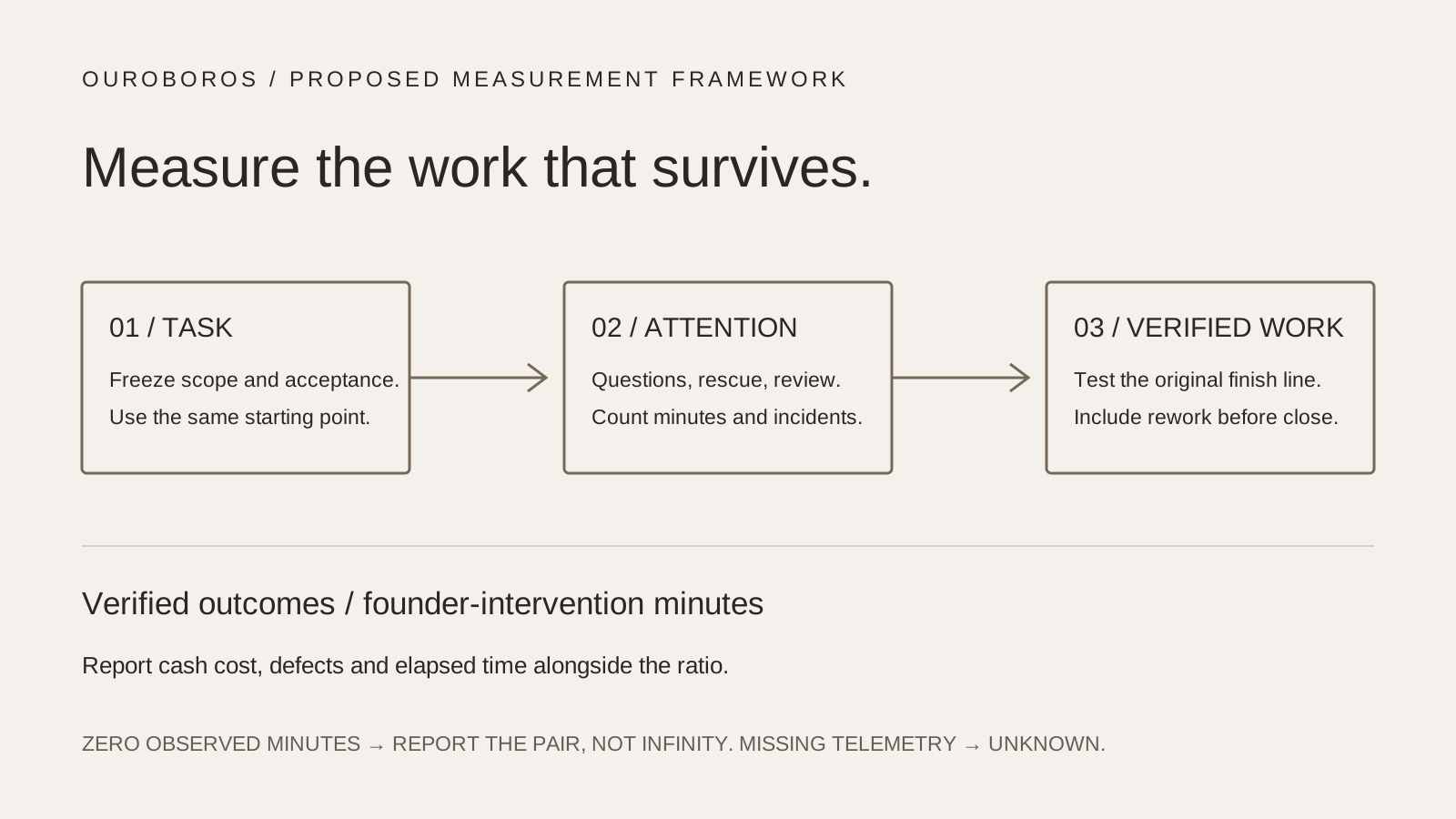
Author-defined measurement framework. No Sol or Astra experiment results are represented.
Parallel work needs a finish line
The September 9 release of Codex CLI 0.154.0 supplies useful infrastructure for this distinction. Its experimental worktree support can create isolated checkouts for new or forked sessions. Inline answers allow work to continue while a question is answered, and saved permissions survive remote resume and fork operations. These are documented workflow capabilities, not evidence of a measured productivity gain. Codex changelog.
Isolation helps compare alternatives without letting both overwrite the same working files. It does not choose a winner, prevent every shared-resource collision or decide what should enter production. Two branches can both pass a narrow test while solving different problems. A model can also make an impressive change beyond the assigned scope. The comparison therefore needs one task contract, one starting revision, explicit permissions and a common acceptance boundary.
For a first experiment, choose a real cross-file change with a deterministic result and reversible consequences. Freeze the task before either model begins. Give Sol medium and Astra medium the same source context, tools, permissions and tests. Keep their outputs separate and record any assistance supplied afterward. An extra explanation given to one competitor is a treatment difference, even when the founder considers it obvious.
Use a single integration owner. The winning branch should meet the original acceptance criteria, respect the agreed file scope and preserve unrelated work. A combined solution is permissible only if the integration and revalidation costs are counted separately. Otherwise the apparent winner quietly receives free human engineering. This is a proposal for a controlled comparison; no paired result is claimed here.
Put founder minutes beside model dollars
The current standard API pages list Astra at $10 per million input tokens and $50 per million output tokens, compared with Sol at $4 and $20. Those input and output rates are each 2.5 times Sol’s. Actual bills also depend on token volume, caching, context length, service tier and tools. The ratio is a price comparison, not an end-to-end cost ratio or a promise of equivalent usage. Astra model page, Sol model page.
A usable accounting identity is total economic cost = model and tool charges + infrastructure charges + founder intervention minutes × an explicit attention value + other measured recovery costs. Count charges from failed attempts in the same job total. Count human rework in intervention time. Avoid charging the same recovery twice merely because it appears in both a trace and a calendar note. Report cash spending and the imputed attention component separately.
For illustration, suppose an Astra route costs $6 more in model and tool charges and saves twelve measured founder minutes. Its break-even attention value is $0.50 per minute, or $30 per hour. That threshold follows from six divided by twelve. It says nothing about the value of a specific founder’s time. If the saving falls to two minutes, the threshold rises to $3 per minute, or $180 per hour. Small changes in intervention dominate this example.
Do not hide the decision inside a single monetized score. A founder can compare the cash premium, minutes recovered, completion quality and elapsed time directly. Opportunity cost depends on what that time could actually enable. An hour freed during a customer negotiation may have a different value from an hour freed during a quiet afternoon. Record the assumption and show a range rather than calling an arbitrary hourly rate a fact.
Define a result before counting it
The proposed headline metric is verified outcomes per founder-intervention minute. Its numerator must come from a task registry established before execution. A finished article, a passing repair or a reconciled evidence record can be one outcome if its completion criteria were fixed. Ten intermediate files do not become ten outcomes simply because an agent generated them. Task splitting must never inflate the numerator after the work is done.
For heterogeneous tasks, report separate cohorts before attempting weighted aggregation. A typo repair and a cross-system incident should not compete as interchangeable units. If weighting is necessary, define weights prospectively and disclose them. Keep completion rate, defects discovered after release and scope violations visible beside the ratio. High throughput with silent damage is a failed operating process, even when its dashboard looks efficient.
Zero measured intervention requires special handling. Report the number of verified outcomes and zero observed minutes as a pair; leave the ratio undefined instead of displaying infinity. Missing intervention telemetry is UNKNOWN, never zero. A founder who ignored every message during a run may still face a review bill later. Define an observation window that includes acceptance and a reasonable check for subsequent rework before closing the record.
The denominator should distinguish question time, necessary judgment, repeated approval, rescue, review and rework. Record interruption count separately from duration. Five quick clarifications can fragment a day differently from one scheduled review, yet that difference should remain a measured observation or explicit hypothesis. The system improves when it can show where attention went and which part was avoidable.
Make escalation earn its place
A practical routing hypothesis is Sol for bounded implementation, Astra for unresolved ambiguity, difficult recovery or consequential review, followed by deterministic validation. The word hypothesis matters. The right route depends on the task distribution and measured outcomes. A strong model might be economical from the start on one task family and wasteful on another. Neither brand nor a single successful demonstration establishes a universal assignment.
Escalation should carry a compact evidence packet: the task contract, current revision, failure observed, attempts already made and the smallest unresolved question. That packet lets the next model start at the frontier of the problem. Replaying the entire history without identifying the actual failure can multiply tokens while preserving confusion. Asking the founder to reconstruct the failed run transfers the recovery burden to the scarcest participant.
A bounded retry policy belongs beside the route. After a specified failure condition, the agent changes method, gathers missing evidence or escalates to the designated technical reviewer. It should avoid endlessly repeating a command that fails for the same reason. A legitimate human boundary remains intact: identity, business intent or a newly consequential commitment may require the owner’s decision. Fewer questions must never become permission to invent authority.
The integration owner then tests the selected artifact against the original requirements. A trace grader can explain routing quality, unnecessary questions or instruction violations. It cannot turn a failing executable test into a successful repair. Keep deterministic acceptance and evaluative judgment distinct so that a polished explanation cannot substitute for a working result.
A trace becomes useful when it changes a decision
OpenAI’s agent evaluation guidance describes traces covering model calls, tools, guardrails and handoffs, with structured graders to identify workflow regressions. It recommends moving toward repeatable datasets and evaluation runs once the team knows what good performance means. That supports a measurement loop; it does not automatically measure founder attention or certify the quality of a particular routing policy. Agent evaluation guidance.
Add a small interruption record to each task rather than collecting a mountain of conversation text. A timestamp, reason, elapsed human minutes, authority category and linked outcome usually provide a more useful starting point. Preserve privacy and avoid copying sensitive source bodies into an evaluation dashboard. The evidence needed to explain a decision is often smaller than the full transcript of everything that happened.
Review losses as carefully as wins. Did the model lack context, ask for information already present, misread authority, fail to recover a dependency, or choose a solution that expanded the diff? Those failure categories suggest different interventions. Better retrieval may solve one problem; a clearer retry policy may solve another. Replacing every failed route with a larger model can conceal a defective task contract.
Routing memory should contain a scoped lesson with its evidence, date and expiration condition. A result from one codebase and one task family should remain local until it survives further comparison. Keep the previous rule available for rollback. Use a held-out task to check whether the proposed lesson improves behavior outside the example that created it. Otherwise the system becomes excellent at explaining yesterday.
A vendor demonstration leaves the economic question open
OpenAI’s architectural visualization example shows Astra carrying an editable scene through Blender work and an Unreal workflow, with inspection and iteration across tools. It is useful evidence of a vendor-demonstrated workflow. It is not a controlled comparison against Sol and provides no matched accounting of founder intervention, repeated failures or total economic cost. OpenAI architectural visualization demonstration.
The investment implication is narrower and more useful than declaring a model winner. Cross-tool continuity creates an opportunity to remove coordination that previously sat with a human operator. Whether the opportunity becomes a return depends on the reliability of the handoffs and the effort needed to inspect them. An editable deliverable with reproducible checks is easier to evaluate than an attractive final image with an opaque production path.
This is where an operator can outperform a benchmark reader. Ask what the founder still had to supply, which corrections were necessary and whether the outcome remained usable after the demonstration ended. Compare a relevant local task under equal conditions. Keep capabilities demonstrated by a supplier separate from economics observed in one’s own operating environment.
Murphy belongs inside the experiment
Start with notification flooding. An agent can report constant activity while requiring the founder to keep checking whether anything important happened. Separate informational progress from a decision request and record how often messages cause intervention. Silence is also an unsafe shortcut if failures remain hidden. The goal is reliable visibility with a clear exception channel, measured against completed work.
Next test repeated approval. Supply authorization in the task contract and see whether the agent carries it across routine recovery. A duplicate request should count as avoidable interruption. A material scope change should still trigger the appropriate gate. Rewarding the smallest question count without checking authority could train a system to become confidently reckless.
Then test branch conflict and false victory. Both competitors should encounter a realistic shared interface or dependency. Check whether they preserve unrelated files, explain integration constraints and pass the same acceptance suite. Include at least one failure-path test appropriate to the change. A branch that deletes a failing assertion or narrows the requirement has changed the contest rather than won it.
Finally test memory poisoning. Feed the review process an apparently successful run whose receipt contradicts its summary. The system should preserve the contradiction and reject the lesson until it is resolved. A bad rule written into future routing multiplies one error across many tasks. Updating memory deserves a stronger evidence boundary than writing a celebratory recap.
One experiment with an honest close
The next action is one paired, reversible task. Record the common starting revision and acceptance contract, then run the two routes separately. Track model and tool charges, elapsed time, intervention count and minutes, retries, scope compliance and the final verification result. Include integration and review time before deciding. Preserve each artifact so the conclusion can be inspected later.
Adopt a route only when its result satisfies the task and its trade-offs are acceptable. If one route completes the task and the other fails, record that bounded outcome. If both pass, compare attention and cash without hiding quality differences. If neither passes, preserve the failure and repair the experiment or task contract. Do not promote a model simply because its explanation sounded more senior.
Today’s published output is the measurement framework, source review and experiment specification. The paired experiment’s completion, founder minutes, cost saving and winning route remain UNKNOWN until actual receipts exist. That distinction is part of the thesis: autonomous work earns trust by closing the distance between a claim and a verified result.
A one-person company becomes more scalable when the founder can spend attention on intent, relationships and judgment while routine execution closes itself. The model bill is visible every month. The interruption bill is scattered across the day. Put both beside the work that survives verification, and the routing decision becomes an operating decision.
Categories and keywords
Categories: Artificial Intelligence; Operating Systems; Founder Productivity.
Keywords: founder interruption tax; verified outcomes; agent evaluation; Sol; Astra; worktrees; routing memory; total economic cost.
Hashtags: #AgenticAI #FounderProductivity #AIInfrastructure #Ouroboros