01 · AI Circularity Ledger
Visible Without Surrender
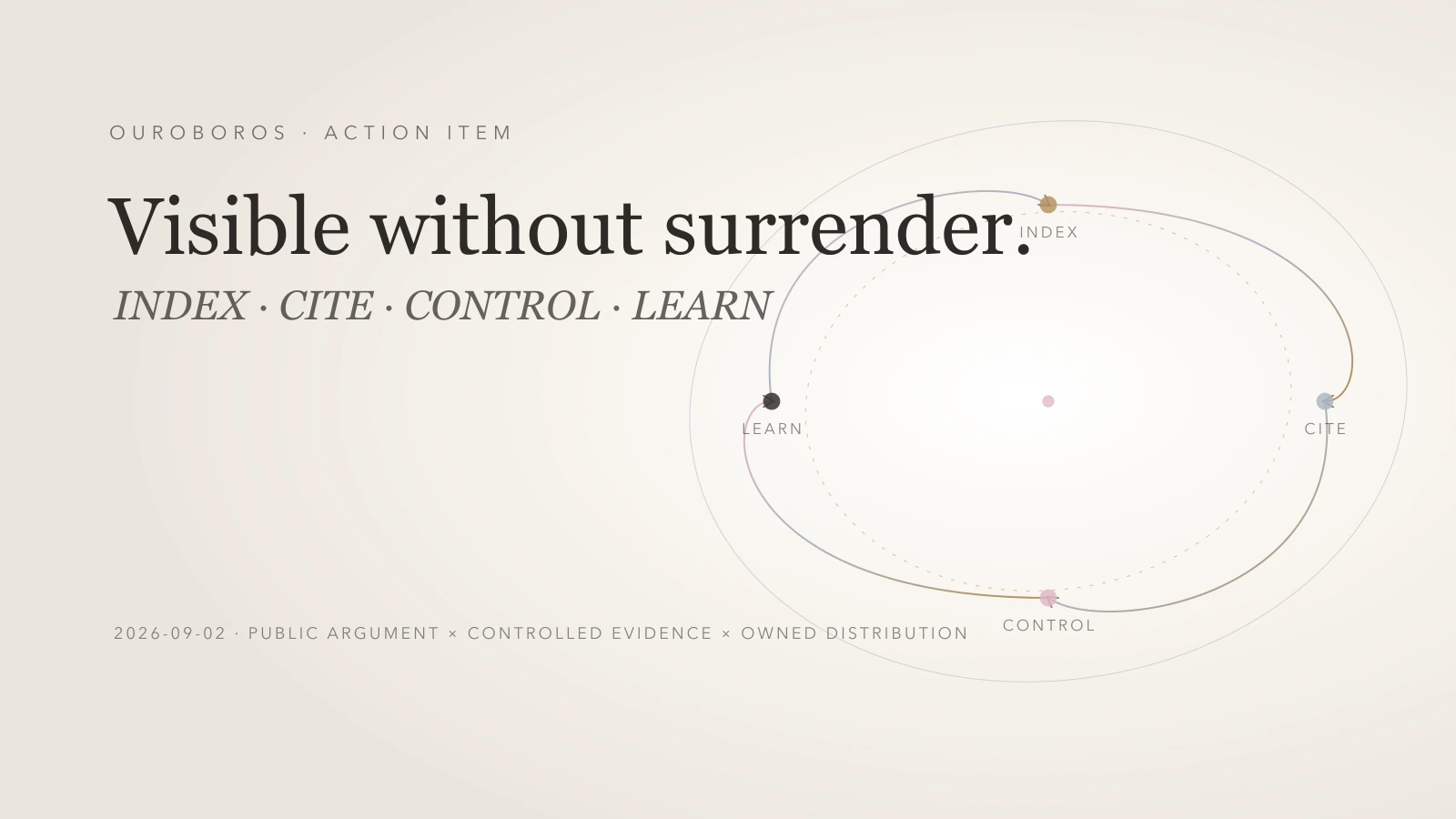
A commercial loop with a scoreboard.
The conclusion is selective visibility
The conclusion is simple: iamrobin.ai should remain visible in Google’s AI search features while publishing in layers. The public layer should contain Robin’s original argument, dated evidence, explicit uncertainty and a stable canonical URL. High-value datasets, private working models and operational records should remain under Robin’s control. Distribution should extend beyond any single search platform. Measurement should decide where that boundary moves next.
Google’s new control makes the tradeoff unusually explicit. A site can leave AI Overviews, AI Mode and related generative surfaces while preserving eligibility for traditional search. Google also states that an opted-out site will receive neither traffic nor impressions from those generative features. The switch changes exposure. It does not create a new way to remain cited while withholding every supporting page.
For an advertising publisher, lost clicks can directly reduce revenue. Robin’s economics are different. iamrobin.ai is an identity, research and intellectual-capital system. Its highest-value outcome is that a future investor, collaborator, employer, reader or AI agent can find a useful idea, verify who wrote it, inspect the sources and return to Robin’s canonical work. Discovery therefore has value even when the first interaction happens inside an answer engine.
That value has limits. A page that gives away a complete proprietary dataset, executable model or private research trail may help a platform answer questions while erasing Robin’s reason to be visited. The operating answer is selective visibility: publish the decision-ready argument; protect the scarce machinery that produced it; measure whether the public layer creates citations, qualified visits and useful downstream relationships.
Google’s switch controls a discovery surface
Google’s June announcement describes a Search Console toggle for managing whether a site’s links and content appear in, and help ground, AI Overviews, AI Mode and related generative Search features. Google updated the announcement to say the control had rolled out worldwide by August 31, 2026. The company says sites that opt out lose traffic and impressions from those features.
The European policy question remains open. Reuters reported that EU regulators were examining whether the proposal gives publishers a meaningful choice. The European Commission has separately said it is monitoring AI Overviews under the Digital Markets Act and recognizes concerns from the media industry. That is regulatory scrutiny, not a final finding that the control is sufficient or unlawful.
The narrow technical boundary matters. The switch governs Google’s generative Search surface. It does not, by itself, define every form of crawling, indexing, model training, contractual reuse or third-party AI citation. Those are separate systems with different controls and evidence.
Google’s AI-features guidance says a page must be indexed and eligible to show a snippet before it can appear as a supporting link in AI Overviews or AI Mode. The same page also says no special AI schema is required. Traditional search fundamentals still carry the load: crawlability, internal links, textual content, page experience, accurate structured data, useful images and reliable people-first material.
This creates a real commercial choice. Opting out may reduce extraction through Google’s generative answers, yet it also removes a large discovery channel. Staying in preserves the possibility of citation and referral, while accepting that some readers will receive enough information from the answer itself. Neither state proves value. Both require measurement.
Four uses of content require four decisions
The phrase “AI used my content” hides four distinct events.
Indexing means a crawler fetches and stores enough information to retrieve a page for search. It is the prerequisite for traditional Google discovery. A canonical URL, crawlable HTML, useful text, sitemap inclusion and internal links make the page addressable.
Citation means an answer or result names or links the page as support. Citation can create authority without a click. It can also generate qualified referrals when a reader wants the evidence, method or author behind the answer. Citation quality depends on stable identity, clear claims and inspectable sources.
Training means content contributes to future model development. Google documents a separate Google-Extended crawler token for controlling whether crawled material may be used for future Gemini models and certain Gemini grounding products. Google’s crawler documentation treats that control separately from ordinary Google Search.
Substitution occurs when an answer supplies enough of a page’s practical value that the reader has little reason to visit the source. Substitution is an economic outcome rather than a crawler category. A concise public thesis may welcome summarization because the author and canonical argument travel with it. A complete proprietary database or detailed operational playbook has very different economics.
One site-wide switch cannot optimize all four. iamrobin.ai needs page-level publishing classes and a content architecture that makes the intended boundary visible.
The three-layer publishing architecture
The first layer is the public canonical argument. It contains the conclusion, the smallest evidence set needed to support it, the author, dates, epistemic labels, source links and a clear action or monitoring frame. It is designed to be quoted accurately. Daily Action Items, selected Intelligence essays and Binary Blog articles belong here.
The second layer is sourced evidence. It includes research dossiers, sanitized tables, public calculations, definitions and dated source trails. Some evidence can remain public because it raises trust and gives a serious reader a reason to visit. Other evidence can be summarized, with the underlying file kept private because it contains licensed data, personal context, operational detail or a reproducible proprietary edge.
The third layer is the private working model. It includes raw datasets, credentials, account data, internal prompts, executable strategy logic, private conversations, job-specific context, unpublished hypotheses and machine-operable controls. This layer is outside the public release tree. Public articles can describe its conclusions and governance boundary without exposing the machinery.
The architecture answers a practical question for every artifact: what must a reader see to verify the conclusion, and what must Robin retain to preserve privacy, safety and future optionality? That is a better test than treating openness as a moral absolute.
The layers also improve correction. If a public claim changes, Robin can update the canonical argument and timestamp the revision. The private working record preserves why the original judgment existed. The evidence layer shows which source or calculation changed. One visible page remains the durable address.
Citation readiness is an editorial discipline
Search engines can index weak pages. AI systems can cite them. Neither event makes the page useful. Citation readiness comes from editorial structure.
Each public argument should lead with one answer, then name the evidence and uncertainty that control it. The title should identify the subject. The page should connect Robin Xie and her Chinese-language name variants as the same author entity through consistent Person data and author links. Publication and modified dates should be real. Article and BreadcrumbList structured data should match visible text. Language editions should carry their own canonicals and reciprocal hreflang links.
Google’s canonical guidance recommends self-referential canonicals and consistent internal links to the preferred URL. This is especially important for iamrobin.ai because one argument may have four language editions, a Binary discovery entry and social derivatives. The English canonical should remain the authorial source; each translation should point to its own language URL and identify the English original.
Source links should sit beside the claim they support. Derived calculations should be labeled as calculations. Company statements, independent reporting and Robin’s inference should remain distinguishable. UNKNOWN should survive when evidence is missing. These choices make the page easier for humans and machines to quote without collapsing fact and judgment.
The public page should also give readers a reason to continue. A strong article can reveal the decision framework while reserving a tool, dataset, worksheet or ongoing ledger for deeper engagement. The link earns its click through additional value rather than by hiding the conclusion.
Preview controls belong at the page and passage level
Google offers controls more granular than a full exit. Its robots-meta specification documents nosnippet, max-snippet and data-nosnippet. max-snippet limits how much text may appear in search snippets and how much can serve as direct input to AI Overviews and AI Mode. data-nosnippet can exclude specific div, span or section content from snippets while leaving the rest of the page eligible.
These controls should be used surgically. A public canonical argument needs enough visible text to be understood and cited. A long proprietary table, licensed excerpt, personal case detail or operational appendix may deserve data-nosnippet, redaction or private storage. A page whose entire value depends on a confidential tool may deserve a public abstract and a separate protected artifact.
Preview directives have costs. A very low max-snippet may reduce both generative inclusion and the usefulness of ordinary search results. nosnippet can remove the text that would persuade a reader to click. noindex removes the page from search eligibility and should never be used as a casual canonicalization tool.
The default for iamrobin.ai should therefore remain indexable, snippet-eligible public argument pages. Exceptions should be attached to a concrete value or privacy risk, recorded per page and reviewed after real evidence appears.
Owned distribution prevents platform dependence
Visibility inside Google is useful. Dependence on Google is fragile. The same article should have paths back to Robin that a platform cannot unilaterally erase.
The canonical website is the first owned surface. It preserves URLs, revisions, language editions, schema and internal relationships. An email list or direct notification channel can become the second. LinkedIn remains a rented distribution surface that points back to the canonical source. Telegram completion receipts prove publication to Robin; they are operational evidence rather than public reach.
This architecture changes the negotiation. Google can alter presentation, measurement or eligibility. LinkedIn can change feed distribution. Robin still owns the authoritative page, the source record and the relationship with readers who choose a direct channel.
Social derivatives should compress the argument instead of copying the full article. The opening earns attention, one diagram carries the mechanism, one question invites thought and the canonical link offers the complete sourced version. If a platform sends no useful reader back, Robin can reduce effort there without losing the underlying asset.
Measure citations, referrals and reuse
Google says AI Overview and AI Mode links are included in Search Console’s Web performance reporting. Search Console’s measurement documentation explains that external-link clicks count as clicks, eligible visible links can count as impressions and AI Overview links share the overview’s position. The data does not expose every answer-level citation as a distinct, perfect dataset.
The learning loop therefore needs several measures:
- Search Console impressions, clicks, CTR and query families for each canonical page.
- Referrals from Google, LinkedIn and other answer engines where observable.
- Direct traffic and returning readers after publication.
- Verified AI citations collected through bounded, reproducible query checks.
- Downstream reuse: backlinks, newsletter mentions, invitations, collaborations and internal RobinOS retrieval.
- Value leakage: full-answer substitution, copied tables, unattributed reuse and licensed-data exposure.
The first decision window should be 90 days, not a daily ranking chase. Establish a baseline for public argument pages, then compare pages with ordinary snippets against a small set using carefully chosen passage controls. Change one variable at a time. Preserve UNKNOWN where Search Console or referral data cannot identify the exact generative surface.
The upgrade test is economic. Stay broadly visible when citations, qualified visits, direct relationships or useful reuse increase. Tighten controls when complete value is repeatedly substituted without attribution, referral or strategic benefit. Reopen material when the protected layer itself prevents readers from verifying a claim.
The operating rule
iamrobin.ai should opt into generative discovery by default for public canonical arguments. It should keep private working models outside the release tree, expose only the evidence needed for verification, and apply passage-level controls when a specific public section creates a documented risk.
Every new longform page should ship with five fields in its publication record:
- Public value: the conclusion and evidence a reader may quote.
- Protected value: the dataset, model, operational detail or private context retained by Robin.
- Discovery state: indexed, snippet-eligible and included in AI search unless an exception is recorded.
- Measurement window: the date and metrics for the next review.
- Change trigger: the evidence that would widen or narrow public access.
This is visibility with memory. Robin publishes enough to be found, enough to be trusted and enough to compound. She keeps the scarce machinery under her control and lets observed outcomes, rather than platform rhetoric, decide the next move.
Categories and keywords
Categories: Artificial Intelligence, Publishing, Digital Strategy
Keywords: Google AI Search opt out, AI Overviews publisher controls, AI Mode traffic, citation-ready publishing, max-snippet, data-nosnippet, Google-Extended, Search Console AI traffic, independent writer distribution, intellectual capital
Hashtags: #AISearch #IndependentPublishing #DigitalSovereignty #SEO #IntellectualCapital