01 · AI Circularity Ledger
The Megawatt Is Not the Asset
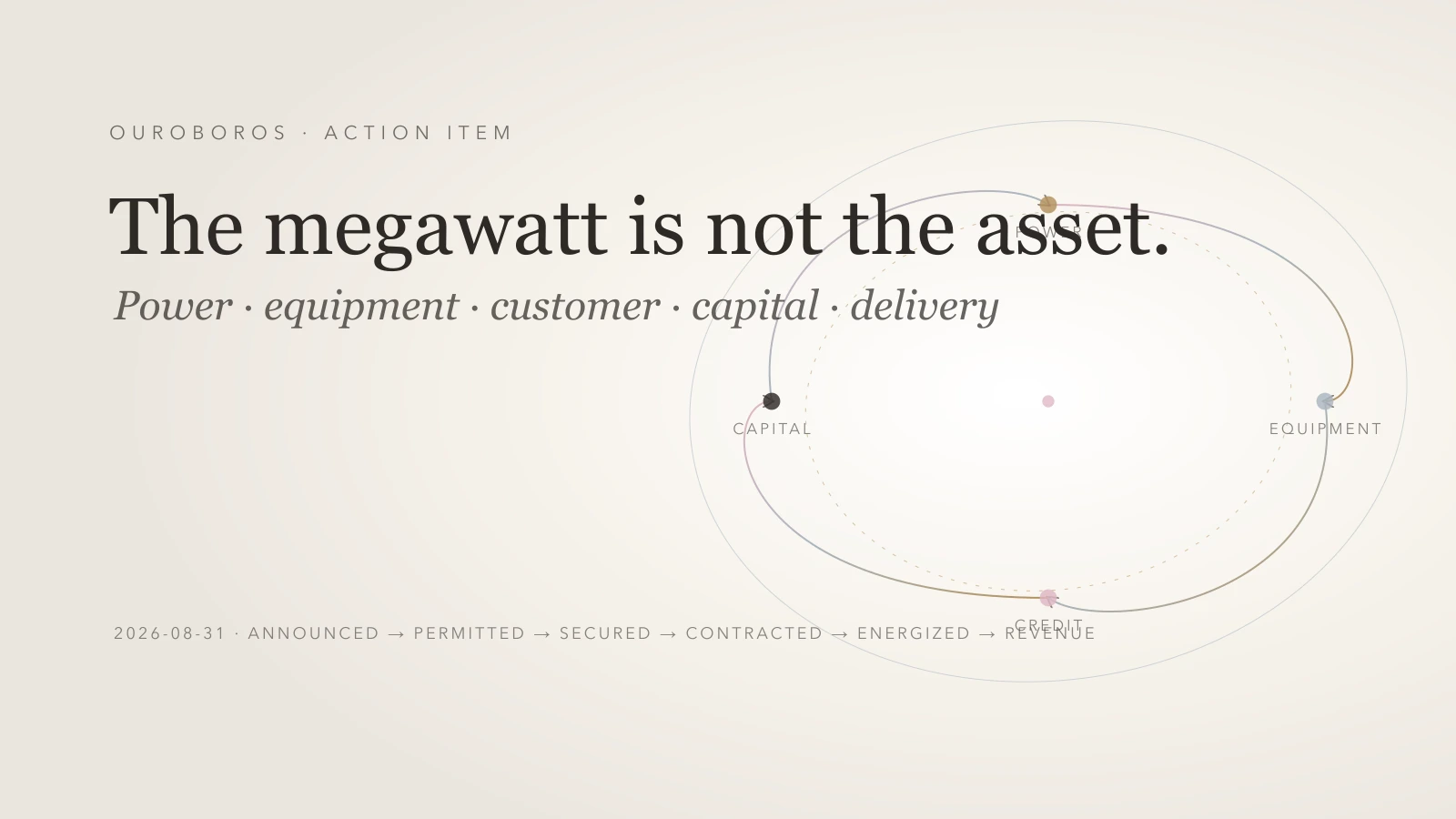
A commercial loop with a scoreboard.
The conclusion is deliverability
The conclusion is direct: an announced megawatt has no investment value until a credible chain connects power, equipment, customer credit, capital and a revenue start date. The useful unit for AI-infrastructure underwriting is the deliverable megawatt. It is a megawatt that can be energized on schedule, converted into working compute, accepted by a creditworthy customer and paid for under terms that survive delay, default and technology change.
The market usually begins with the largest visible number. A campus announces one gigawatt. A developer presents a multi-gigawatt pipeline. A laboratory signs a long-term capacity arrangement. A chip supplier helps assemble financing. These events matter, yet each sits at a different point between aspiration and cash flow. Combining them into one capacity figure creates false precision.
The current evidence makes the distinction urgent. Reuters reported that Anthropic had committed about $45 billion over six years for roughly 460 MW of Vera Rubin capacity at Nscale’s Monarch campus, with delivery expected to begin in late 2027. Anthropic had not publicly confirmed the contract at the research cutoff, so the arrangement remains REPORTED_UNCONFIRMED. It should inform a credit model without being treated as a completed, operating asset.
Financial Times reporting placed that commitment within a broader 1.35-GW data-center plan and an associated 2-GW gas-power project. Scale creates options. It also multiplies the number of interfaces that must arrive together: fuel, turbines, grid connection, environmental permits, transformers, cooling, GPUs, networks, buildings, customer acceptance and financing draws.
The decision today is BUILD. Use one six-stage funnel and one deliverable-MW card for every AI campus. Keep announced capacity outside valuation. Give permitted, equipment-secured and contracted capacity increasing but still conditional credit. Treat energized capacity as an operating asset only after commissioning. Count revenue megawatts only when accepted compute produces collectible cash.
Six stages separate story from asset
The first stage is announced MW. It may describe a land position, a power ambition, a memorandum, a preliminary utility discussion or a marketing pipeline. Announcement proves intent and gives a search boundary. It does not prove land control, interconnection, generation, permits, equipment, customer credit or funding. Assign no base-case revenue and no construction certainty to this stage.
The second stage is permitted MW. The term must be specific. A land-use approval is different from an air permit, grid interconnection, water approval, gas connection or building permit. Record each permit, issuer, capacity, effective date, expiry, appeal exposure and remaining condition. A site can have planning permission while its power plant, substation or transmission path remains unapproved. Underwriting should name the weakest necessary permit rather than reporting a blended percentage complete.
The third stage is equipment-secured MW. AI campuses depend on long-lead transformers, switchgear, turbines, cooling equipment, networking and accelerator systems. A purchase order can mean a refundable reservation, a non-refundable deposit, a firm manufacturing slot or a delivered asset. Record vendor, specification, slot date, deposit, cancellation rights, warranty, substitution rights and performance security. Equipment is secured only when the delivery path is contractually credible and compatible with the site’s power and cooling design.
The fourth stage is contracted MW. A customer announcement is insufficient. The contract needs a defined quantity, service level, commencement date, acceptance procedure, minimum payment, indexation, remedies, termination rights, credit support and change-control mechanism. A laboratory may have strong strategic demand and weak standalone credit. A long contract can still finance poorly if payments begin only after flawless delivery or if delay lets the customer exit without compensating lenders.
The fifth stage is energized MW. Power must reach commissioned electrical and cooling systems at the required quality. First power is different from full campus power. A gas plant may produce electricity while transmission, backup, cooling or data halls remain incomplete. Count only capacity that has passed commissioning tests and can support the contracted compute envelope. Name any curtailment, fuel, maintenance or grid constraint.
The sixth stage is revenue MW. This capacity has powered accepted equipment and produces contractually collectible revenue. Record customer acceptance, billable start, utilization, availability, service credits, collections and operating cost. Revenue MW is the closest unit to an asset, though it still carries customer, equipment, power-price and residual-value risk.
The funnel should reconcile numerically. If a project announces 1,350 MW, permits 600 MW, secures equipment for 460 MW, contracts 460 MW, energizes zero and produces zero revenue today, the underwriting table must show all six figures. It must not describe the project simply as a 1.35-GW asset.
Customer credit converts capacity into finance
The reported Anthropic–Nscale arrangement illustrates why customer credit belongs in engineering diligence. A six-year, $45-billion commitment implies roughly $7.5 billion of annual capacity obligation if the headline amount is spread evenly. That arithmetic is a scale indicator, not a payment schedule. Actual financeability depends on when payments begin, whether they are fixed or usage-linked, what acceptance requires and which remedies apply when delivery moves.
Start with the contracting entity. Determine whether the customer obligation sits at the AI laboratory, a subsidiary or another vehicle. Identify parent guarantees, deposits, letters of credit, equity support and termination payments. A celebrated customer name cannot replace the executed credit package.
Next, map commercial operation date risk. If the campus misses COD, the customer may receive delay credits, defer minimum payments, reduce capacity or terminate. The developer may owe lenders while customer cash has not started. Underwriting therefore needs a delay bridge: sponsor equity, interest reserve, contractor damages, insurance, customer advance or another source that covers the gap.
Minimum payments matter more than theoretical peak demand. A take-or-pay obligation can support debt if it begins at an objective milestone and survives ordinary utilization changes. A purely usage-based arrangement transfers demand risk to the project. Hybrid structures split fixed availability revenue from variable compute consumption. Every model should show the fixed portion, variable portion, ramp, escalation and termination value.
Acceptance testing deserves its own schedule. Rubin systems, networking, power and cooling must operate as one service. Define the performance test, duration, benchmark, availability, remediation window and deemed-acceptance rules. A data hall can be electrically complete while the customer refuses service because the integrated compute cluster misses performance or reliability requirements.
Finally, test customer concentration. A single anchor can make financing possible and make the asset fragile. The model needs a default case, a downgrade case and a delayed-ramp case. Record the time and cost to re-market the power, buildings and equipment. The larger the single-customer commitment, the more valuable an explicit replacement path becomes.
Asset topology determines who absorbs delay
SK Telecom’s announcement provides a useful capital-structure contrast. The company described SK Horizon as holding 318 MW across operating and under-construction assets, supported by KRW 3.08 trillion from KKR and IMM, with final ownership of 51% for SK Telecom, 29% for KKR and 20% for IMM. It also described a separate SK Hyper development ambition of 5 GW by 2029 and 15 GW by 2035.
The two capacity sets should carry different valuation treatment. Operating assets belong in an OpCo model with observed revenue, uptime, cost and customer concentration. Under-construction assets belong in a construction model with remaining spend, schedule, contingency and pre-leasing. Long-range development capacity belongs in a DevCo model with option value and milestone probabilities. Adding all three and applying one operating multiple overstates delivery.
For each project, draw the legal and contractual topology. Identify who owns land, interconnection rights, generation, buildings, electrical equipment, GPUs and customer contracts. Identify which entity borrows, which provides completion support and which receives customer payments. Map cash waterfalls and security. A data-center logo can conceal several entities with very different creditors and remedies.
Delay follows the weakest interface. A utility may miss interconnection. A turbine may arrive late. A building contractor may miss completion. A GPU vendor may reallocate supply. A customer may fail acceptance. The contract stack should push risk toward the party able to control it, while the financial model should retain a residual contingency when recovery is limited or disputed.
Use three values rather than one. Operating value applies only to revenue MW with observed economics. Committed development value applies probability-weighted economics to contracted, permitted and equipment-secured stages after deducting remaining capital and delay reserves. Option value applies to announced pipelines with land or power rights that could support a future project. Option value can be real; it should never masquerade as operating cash flow.
Capital expands demand and redistributes risk
NVIDIA reported second-quarter fiscal 2027 revenue of $96.221 billion, Data Center revenue of $89 billion, gross margin of 75% and a $108-billion plus or minus 2% revenue outlook. It also said proposed financing platforms with Apollo, BlackRock, Blackstone, Brookfield, Goldman Sachs and KKR could mobilize more than $500 billion for AI infrastructure over time, subject to definitive agreements.
Third-party infrastructure capital can accelerate genuine deployments. It can also move risk away from the first buyer and into lenders, special-purpose vehicles, suppliers and residual-value holders. The correct question is not whether $500 billion is bullish. It is who contributes cash, who guarantees payment, who owns the equipment, who takes technology obsolescence and what happens if the end customer slows consumption.
Supplier-supported finance can be productive when risk is transparent and bounded. A vendor may reserve equipment, provide a guarantee, invest equity, support an SPV or arrange lenders. Each action can increase capacity that later buys the vendor’s products. That circularity does not make the demand fictitious. It does require a separate ledger for cash funded by independent customers, cash funded by third-party capital and risk retained by the supplier.
Track five financing layers: sponsor equity, customer support, construction debt, equipment finance and long-term takeout. Record funding conditions, draw sequence, interest during construction, completion guarantees, covenants, refinancing assumptions and residual claims. A project is financeable only when committed sources cover uses, contingencies and the delay case.
Technology life must match debt life. Accelerators can lose economic value faster than buildings and power systems. Split residual value into land and interconnection, power infrastructure, shell and cooling, network equipment and accelerator systems. Use different depreciation, reusability and re-leasing assumptions. A campus with scarce power may retain value after one GPU generation; a specialized rack configuration may not.
OpenAI’s capability map confirms the integration problem
OpenAI’s Compute Strategy role describes work spanning power, land, colocation, cloud, silicon, networking, equipment and capital-markets transactions, from sourcing and diligence through negotiation and post-signing governance. The job description is evidence about the industry’s integration requirements. It is not evidence that a particular campus is complete or a reason to create a public career page.
The capability map explains why AI infrastructure cannot be underwritten by a single discipline. Electrical and civil engineering determine physical feasibility. Supply-chain work secures long-lead equipment. Commercial contracts turn technical delivery into payment. Credit analysis determines whether the promise supports finance. Capital structuring assigns risk. Operating governance keeps milestones, changes and claims visible after signing.
Robin’s advantage sits at these interfaces. A professional engineer can ask whether the power path and design are executable. A payments operator can trace authorization, settlement, reconciliation and failure recovery. A capital allocator can distinguish operating assets, committed developments and options. The common discipline is to follow the constraint until it reaches cash.
Use the role description as a checklist. Every campus review should cover origination, technical and commercial diligence, negotiation, capital approval, execution, governance and portfolio monitoring. Missing ownership at any stage is a risk state, not an invitation to assume someone else has solved it.
The deliverable-MW card
The card fits on one page and has eight rows.
Power: Name utility, generation, interconnection, firm capacity, quality, curtailment, price, start date and remaining conditions. Separate grid, behind-the-meter and backup sources.
Fuel: For thermal generation, record supply, transport, storage, price, emissions permits, water and outage coverage. A generation nameplate without fuel assurance is announced power.
Permits: List land, building, air, water, transmission, generation and operating approvals. Record appeal and expiry exposure. Preserve UNKNOWN where evidence is absent.
Equipment: List transformers, switchgear, turbines, cooling, network and accelerators. Record vendor, slot, deposit, cancellation, warranty, performance security and compatibility.
Customer: Identify entity, committed quantity, term, COD, acceptance, minimum payment, variable usage, credit support, remedies and termination value.
Financing: Reconcile sources and uses. Identify equity, debt, equipment finance, customer support, supplier support, contingencies, completion obligations and takeout.
Community: Record land impact, jobs, taxes, grid effect, water, emissions, noise, public process and benefit commitments. Community opposition can become schedule and capital risk.
Exit value: Split value by power rights, site, shell, cooling, network and accelerators. Model customer default, technology change, re-leasing time, conversion cost and liquidation priority.
Each row receives evidence status, owner, date, source, next proof and decision effect. The final card reports all six MW stages, expected revenue start, remaining capital, delay reserve and the binding constraint. If the evidence is missing, the value remains UNKNOWN. It does not become zero, complete or financeable.
Decision rules for capital allocation
The first rule is to value stages separately. Revenue MW can support an operating multiple when revenue quality and cost are observed. Energized MW can receive near-operating value after commissioning and customer acceptance are sufficiently probable. Contracted, equipment-secured and permitted MW receive probability-weighted development value. Announced MW receives only bounded option value.
The second rule is to price interface risk. A project with excellent power and uncertain GPUs differs from a project with secured GPUs and uncertain power. Probability trees should reflect the sequence and correlation of milestones. Common stress cases include twelve-month COD delay, customer downgrade, equipment substitution, power-price increase, lower utilization and reduced GPU residual value.
The third rule is to separate project return from sponsor narrative. Calculate return on cash actually funded, debt actually drawn and revenue actually collectible. Exclude uncommitted future phases from base-case coverage. Show whether the sponsor earns development fees, equipment margin, operating fees, equity appreciation or supplier revenue, and identify conflicts.
The fourth rule is to keep circular financing visible. If a supplier’s capital or guarantee helps a customer buy that supplier’s equipment, record supplier revenue and retained credit risk in separate ledgers. If an asset manager supplies independent capital, identify its seniority, collateral and recourse. Demand may be genuine while risk travels back to the vendor.
The fifth rule is to update at milestone boundaries. Re-underwrite when permits become final, equipment slots become firm, customer contracts are executed, debt closes, power is commissioned, compute passes acceptance and collections begin. Do not wait for quarterly narratives to reveal a construction fact that can be monitored directly.
The resulting posture is BUILD — DELIVERABLE_MW / CREDIT_AND_COD_OPEN. Create the card for Monarch and every comparable campus. Keep the reported Anthropic contract labeled REPORTED_UNCONFIRMED until the company or executed evidence confirms it. Give SK Horizon operating assets and future SK Hyper capacity different valuation treatment. Track NVIDIA’s financing platforms only as proposed until definitive agreements identify capital, guarantees and residual risk. The megawatt becomes an asset one proof at a time.
Categories and keywords
Categories: AI Infrastructure, Investment, Engineering
Keywords: deliverable megawatts, AI data center underwriting, project finance, customer credit, GPU residual value, power infrastructure, compute contracts, COD risk, equipment finance, capital allocation
Hashtags: #AIInfrastructure #ProjectFinance #DataCenters #CapitalAllocation #Engineering