01 · AI Circularity Ledger
Your AI Model Is a Supplier
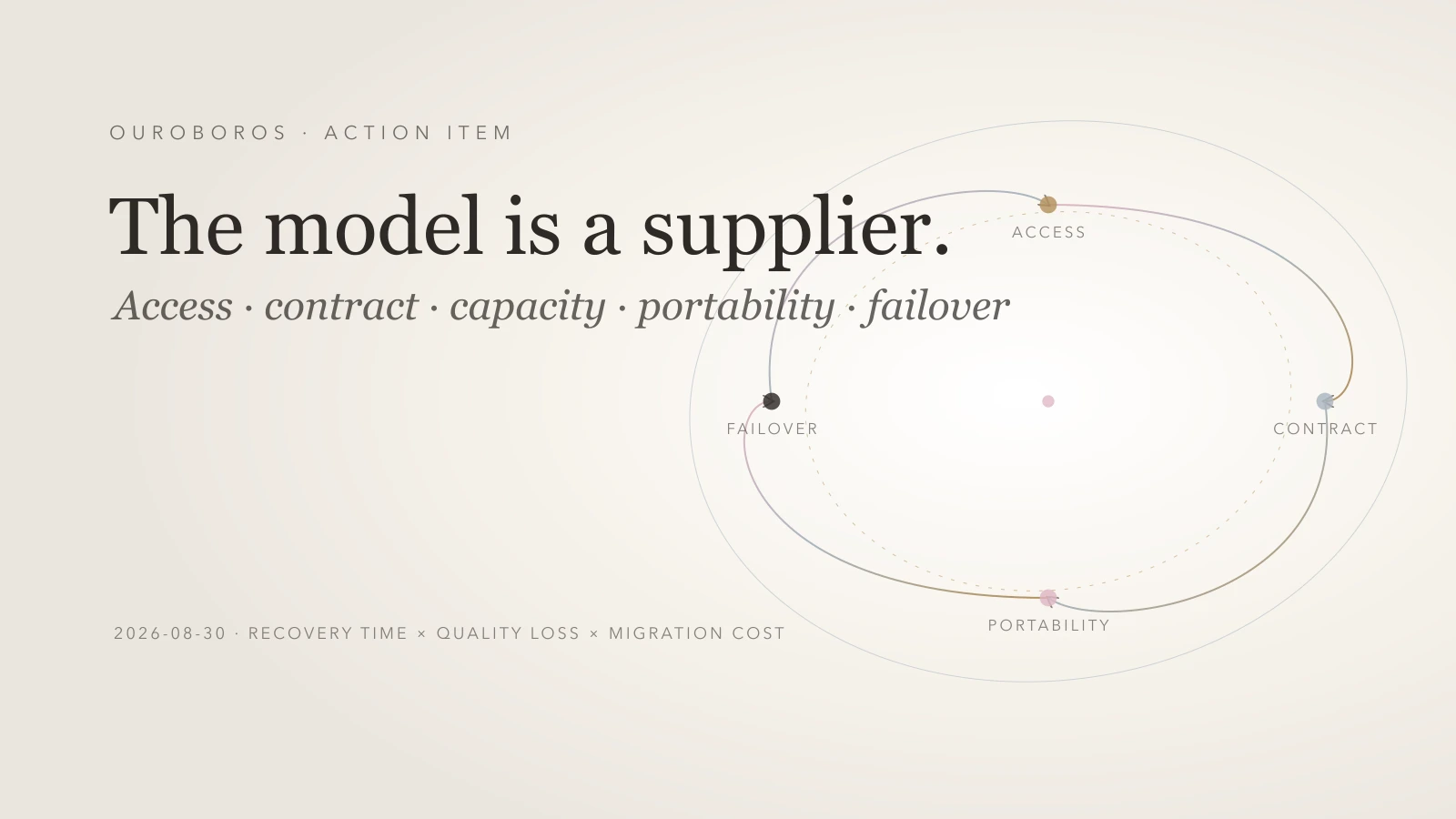
A commercial loop with a scoreboard.
The conclusion is supplier risk
The conclusion is simple: an AI model is a supplier, and an agent platform is resilient only when it can survive a change in that supplier. A model menu creates interface choice. It does not by itself create continuity. Continuity requires five separate capabilities: authorized access, durable commercial terms, sufficient capacity, portable application behavior and a rehearsed failover path.
OpenAI announced on 28 August that it had proposed ending its Cursor relationship on 12 November 2026. OpenAI said the date represented the maximum notice required under its agreement and linked the decision to SpaceX’s acquisition of Cursor and concerns about compliance with its terms. OpenAI also said future models would be excluded from the relationship. This is a proposed supplier exit with a defined notice window, rather than an immediate technical outage.
Cursor staff wrote that OpenAI represented roughly 5% of current traffic, that discussions were continuing and that Cursor maintained direct partnerships with Anthropic, Google, Meta and Grok. Those claims come from Cursor and describe its present routing posture. They do not establish the final commercial outcome, equivalent capacity for every workload or identical behavior across models.
Reuters independently reported the proposed termination and the companies’ positions. The confirmed event therefore changes the planning assumption today: access to a frontier model can become a negotiated, time-bounded dependency after ownership, policy or strategic conditions change.
RobinOS should treat model supply exactly as it treats any critical digital service. The immediate action is a 24-hour portability drill across OpenAI, Anthropic and one additional provider. The output must record recovery time, quality loss, migration labor and unresolved incompatibilities. The decision state is CONDITIONAL until the drill proves a complete public assignment can move between providers without losing evidence, citations, privacy boundaries or release quality.
The Cursor event separates interface choice from supply
Cursor already offered several frontier models. That design reduces the friction of switching a user from one model button to another. Supplier resilience sits underneath that interface. A platform may display three providers while sharing one commercial reseller, one identity path, one tool schema, one evaluation blind spot or one capacity bottleneck. Visible plurality can conceal operational concentration.
The OpenAI–Cursor event exposes three different objects that are often collapsed into “model choice.” The first is product choice: which model appears in the interface. The second is technical choice: whether the prompt, tools, files, structured outputs and safety behavior work with another model. The third is supply choice: whether the operator has authorized, contracted and adequately provisioned access to the alternative when the primary path changes.
Cursor’s statement that OpenAI accounts for about 5% of traffic is relevant. If accurate, it suggests traffic concentration is modest. Yet traffic share alone cannot settle continuity. The 5% may contain high-value tasks, specific customers, unique model behavior or future features. A substitute may accept the same prompt and still differ in tool calls, latency, context handling, refusal boundaries, output stability or price. Resilience is measured at the completed service level, not at the API-call level.
The notice period matters too. A supplier relationship can change through contract enforcement rather than infrastructure failure. That gives an operator time, but only if its code, evidence and decision process are portable before the clock begins. A migration plan written after notice arrives is an emergency project. A migration path exercised in ordinary operation is a capability.
The final outcome remains UNKNOWN. OpenAI and Cursor may agree new terms. The proposed cutoff may proceed. Other suppliers may increase their role. None of those outcomes reverses the planning lesson. A platform whose continuity depends on one provider’s future permission carries supplier risk even while every dashboard is green.
Five layers define the model supply chain
The first layer is access. Record the legal entity holding the account, authentication path, approved use, available regions, eligible model families and version access. A provider name is too broad. Access to today’s model does not guarantee access to its successor. A reseller path is different from a direct relationship. Geography, identity, ownership and use case can each alter eligibility.
The second layer is contract. Map termination rights, notice periods, change-of-control clauses, audit obligations, acceptable use, data rights, confidentiality, liability and model-update terms. The OpenAI announcement shows why ownership events belong in the technical risk register. A contract clause can become a production constraint without any change to the code.
The third layer is capacity. A backup provider with a valid account may still lack the rate limits, regional availability, latency, reserved throughput or burst capacity needed during failover. Normal-day capacity and emergency capacity are separate questions. The operator should know which workloads receive priority, which enter a degraded mode and which pause when the primary supplier disappears.
The fourth layer is portability. This includes prompts, tool definitions, structured-output schemas, file handling, retrieval, memory, safety policy, evaluation cases and evidence export. A common application wrapper helps, but semantic differences remain. One model may call a tool early; another may over-explain; a third may handle uncertainty or multilingual material differently. Portability therefore needs measured acceptance criteria rather than an adapter that merely returns a response.
The fifth layer is failover. Define the trigger, owner, approved alternate, recovery-time objective, degraded service, rollback and evidence trail. A valid failover produces an acceptable artifact, preserves provenance and keeps authority bounded. Success means the service continues safely. A HTTP 200 response is only transport evidence.
NIST SP 800-161 Rev. 1 treats reduced visibility into how technology and services are developed, integrated and deployed as a supply-chain risk. Model APIs fit that pattern. The supplier controls upstream training, model release, policy, capacity and version behavior. The application owner controls architecture, testing, contracts and fallback. Responsibility is shared; accountability for the product remains with the operator.
Portability is an operating capability
Portability starts with a representative assignment, not with a generic benchmark. For RobinOS, choose one task that exercises research, multilingual editing, structured output, local tools, privacy boundaries and public release. Freeze the source package, expected sections, citations, schemas and acceptance criteria. That frozen fixture becomes the common test across providers.
Run the assignment first on the current OpenAI path. Capture elapsed time, prompts, tool calls, schema corrections, human interventions, output quality and total cost. Then move the same fixture to Anthropic. Repeat with Gemini or a credible open-model path. Preserve each artifact and the exact reasons for any failure. The objective is evidence about the system, rather than a beauty contest between model prose.
Score four quantities. Recovery time measures the interval from failover decision to a verified artifact. Quality loss measures material omissions, factual errors, citation failures, translation drift and editorial degradation against the baseline. Migration labor records engineering and human review needed to complete the change. Residual incompatibility lists functions that remain unavailable or unsafe.
A model switch that takes fifteen minutes but silently drops source links is a failed release path. A switch that takes six hours, preserves every fact and requires one well-documented adapter may be adequate. The number has meaning only beside the acceptance boundary.
The minimum RobinOS target should be demanding and understandable: move a representative public assignment from the primary provider to a verified alternate within 24 hours; preserve the immutable source; keep all material claims and citations; prevent private data leakage; retain explicit uncertainty; and produce a release that passes the same deterministic gates. Every exception must be named.
Portability also requires routine use. An alternate provider that is tested once and then ignored accumulates drift. Prompts change, schemas change, models retire and tools evolve. Run the fixture quarterly and after any material model, contract or architecture change. Store results as a time series. A degrading recovery time is an early warning long before a cutoff arrives.
Contract terms and capacity deserve technical ownership
Model procurement cannot sit entirely in legal or engineering. Legal teams can read termination and data clauses. Engineers can measure schemas and latency. Product owners understand which degraded functions users can tolerate. Finance can compare reserved capacity, usage commitments and migration cost. Continuity emerges only when those views meet in one supplier record.
For every critical model path, record whether the relationship is direct or intermediated. Identify the contracting entity and any change-of-control exposure. Record the notice period for termination, the treatment of future models, data retention, training rights, confidentiality and audit. Link those terms to the workloads they support. A contract should have an operational owner, review date and explicit exit trigger.
Capacity needs equal precision. Measure ordinary throughput, peak throughput, rate-limit behavior, regional latency, retry behavior and provider-specific quotas. Ask whether capacity is reserved, prioritized or best effort. Test burst demand rather than extrapolating from average traffic. A supplier can be commercially available and operationally insufficient at the same time.
Anthropic’s announcement of higher limits for SpaceX shows that provider relationships can expand even as another relationship becomes contested. The evidence does not imply interchangeable terms. It shows an asymmetric network: one organization can have different access, capacity and strategic relationships with different model suppliers. Resilience comes from understanding each edge, not from counting logos.
The compact supplier card should contain five rows: ACCESS, CONTRACT, CAPACITY, PORTABILITY and FAILOVER. Each row has an evidence status, owner, last test, expiry or review date, known limit and next action. UNKNOWN remains UNKNOWN. A missing capacity commitment cannot become zero capacity or adequate capacity. It becomes a test and a decision boundary.
A 24-hour RobinOS failover drill
Hour zero begins by freezing the representative assignment and the primary result. The release owner confirms that the fixture contains no credentials or prohibited private material. The owner records the primary model, version, access path, total elapsed time and all deterministic gate results.
During hours one through four, run the fixture through Anthropic using the smallest adapter needed. Preserve prompts and decision rules. Record schema changes, tool-call differences, citations, translation quality and any manual repair. Avoid rewriting the task to flatter the alternate model. The same outcome boundary must apply.
During hours five through eight, repeat with Gemini or the chosen open-model route. If an open model lacks a required capability, record the exact missing function and test the intended degraded mode. A smaller local model may still protect intake, classification or evidence preservation even when it cannot complete the final publication.
During hours nine through twelve, compare outputs against the frozen acceptance set. Check facts, sources, section parity, locale quality, mobile rendering, privacy, schema and authority. Run the same release gates. Every defect receives a label: adapter defect, model-behavior difference, capacity issue, policy issue, evidence issue or unknown.
During hours thirteen through eighteen, repair only the portable layer. Move provider-specific assumptions into named adapters. Preserve one canonical content contract. Add explicit fallbacks for tool names, structured output and retry behavior. Avoid provider-specific content rewriting unless the difference is recorded and justified.
During hours nineteen through twenty-two, rerun the strongest alternate from a clean state. Measure recovery time from trigger to verified artifact. Confirm rollback to the primary path. Confirm that logs and archives identify the actual supplier rather than claiming the canonical model remained in use.
During hours twenty-three and twenty-four, issue a one-page result. The result states PASS, CONDITIONAL or HOLD. PASS requires a verified artifact inside the 24-hour target with no material evidence or privacy loss. CONDITIONAL means the artifact is usable with named limits and owned repairs. HOLD means continuity remains unproved for the critical assignment.
The deliverable is operational evidence. It gives Robin a measured answer to three questions: how long a switch takes, what quality changes and how much work remains. It also creates a prioritized engineering list without turning an external supplier event into panic.
Underwrite the supplier before the model
Model evaluation usually begins with intelligence, speed and price. Critical systems need a second scorecard for supply. A brilliant model with fragile access may be the correct specialist and the wrong single point of failure. A slightly weaker model with direct terms, reserved capacity and tested portability may carry more continuity value.
The underwriting table is concise:
| Supplier event | Evidence | RobinOS response | Status |
|---|---|---|---|
| proposed OpenAI cutoff for Cursor | dated OpenAI statement and Reuters report | map affected access and contract assumptions | CONFIRMED |
| OpenAI share of Cursor traffic | Cursor says about 5% | verify workload value and alternate capacity | COMPANY DISCLOSURE |
| final November outcome | negotiations continue | monitor agreement and model availability | UNKNOWN |
| alternate provider capacity | relationships exist; equivalent limits undisclosed | test representative peak and degraded mode | UNKNOWN |
| cross-provider artifact quality | no current RobinOS drill result | execute the 24-hour fixture | HOLD |
The table prevents two errors. The first is complacency: several model buttons feel like redundancy. The second is overreaction: a proposed supplier exit becomes proof that every multi-model platform will fail. The evidence supports neither extreme. It supports a bounded test.
The investment implication also matters. Agent platforms with direct provider relationships, portable orchestration, transparent capacity and tested failover deserve a continuity premium. Platforms that depend on one supplier while marketing a broad model menu deserve a concentration discount. Model suppliers with strategic capital, compute or ownership relationships may offer different terms to different customers. Contract topology becomes part of product quality.
For RobinOS, the immediate decision is BUILD — TESTED_PORTABILITY / CONTRACT_AND_CAPACITY_OPEN. Complete the drill, create the five-row supplier cards and attach each critical workflow to a named alternate. Keep final negotiations, equivalent capacity and model parity labeled UNKNOWN until evidence arrives. The goal is neither independence from frontier providers nor perfect interchangeability. The goal is a system that can change suppliers without losing its memory, standards or authority.
Categories and keywords
Categories: Artificial Intelligence, AI Infrastructure, Systems
Keywords: model API supply chain, agent portability, model failover, vendor concentration, AI procurement, Cursor, OpenAI, Anthropic, capacity planning, contract risk
Hashtags: #AIInfrastructure #AgenticAI #SupplyChain #OpenAI #Cursor