01 · AI Circularity Ledger
The Customer Built a Better Chip
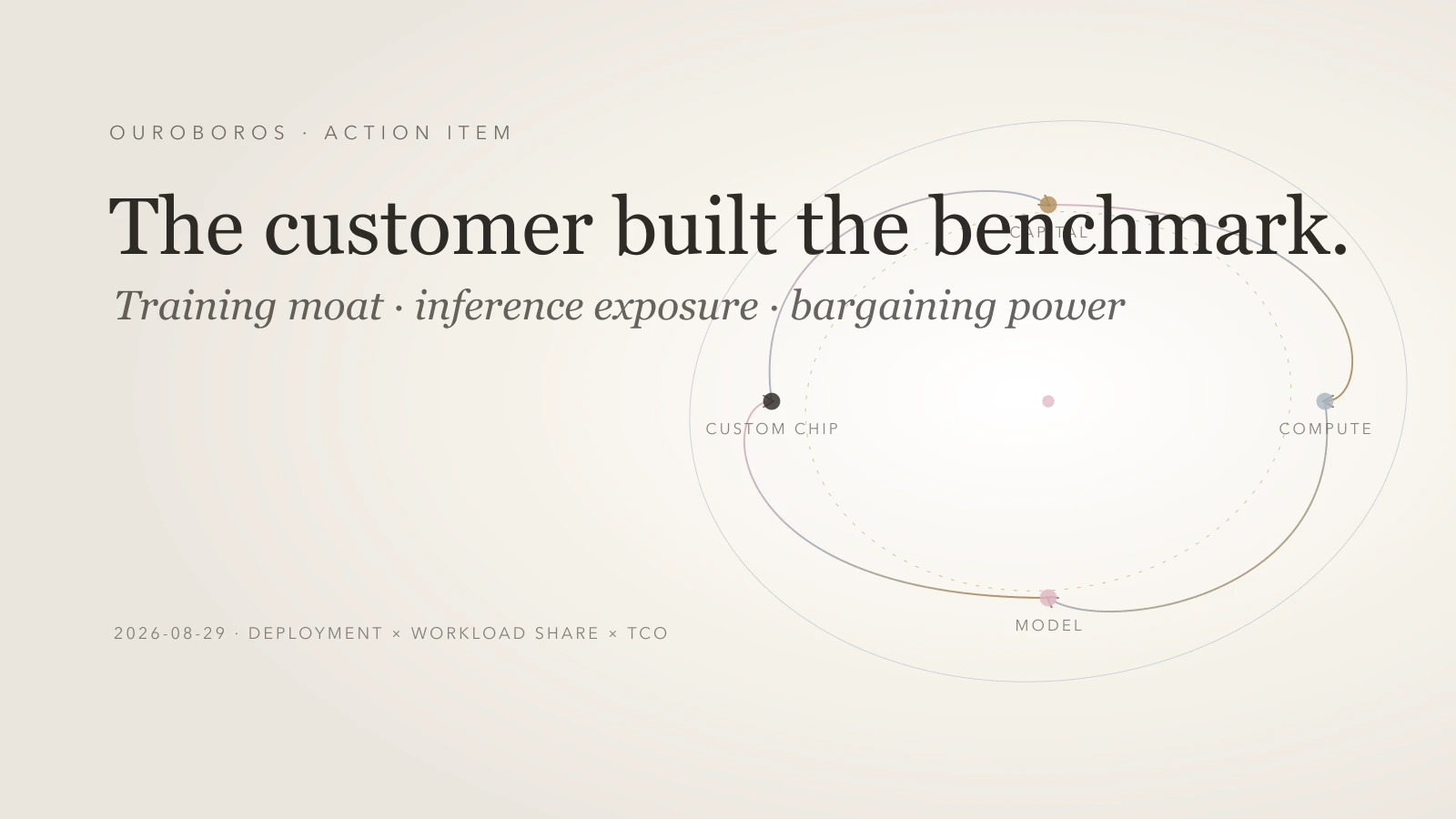
A commercial loop with a scoreboard.
The conclusion is a split moat
The conclusion is direct: OpenAI’s Jalapeño validates custom inference silicon as a real competitive layer, while NVIDIA retains a formidable training platform and an enormous deployment lead. The investment mistake is forcing those two facts into one winner-takes-all verdict. A customer can keep buying NVIDIA systems for training and frontier workloads while moving predictable inference onto its own accelerator. NVIDIA revenue can keep growing as its long-term inference share and bargaining power narrow.
OpenAI’s first published results report that Jalapeño completed 1.5 to 1.9 times more AI work per watt at peak throughput and delivered 1.7 to 3.6 times lower end-to-end latency than the compared GB200 or GB300 systems across GPT‑OSS 120B, DeepSeek R1 670B and Kimi K2.5 1T. The chip has a 700W package rating, with measured sustained power at 550W or less in the tested workloads. OpenAI says deployment begins inside its infrastructure by year-end, with Gen 2 already in development and Gen 3 taking shape.
That is meaningful engineering evidence. It is also first-generation, issuer-led evidence from a system designed around OpenAI’s own serving needs. Production fleet size, uptime, yield, networking cost, memory cost, software maintenance and workload coverage remain undisclosed. The correct decision is WATCH — VALIDATED_INFERENCE_CHALLENGER / NOT_YET_SCALED.
Jalapeño changes one premise immediately: Blackwell is no longer a defensible proxy for an unbreakable inference-efficiency ceiling. It leaves another premise intact: general-purpose accelerated computing, CUDA software, rack-scale networking and a rapid multi-generation roadmap still give NVIDIA a broader platform than one specialized accelerator.
Read the benchmark at system level
The headline numbers compare useful AI work per unit of power and user-visible latency. That is the right direction for inference economics. A chip buyer pays for completed requests, power, cooling, memory, networking, software and reliability. Peak arithmetic capability alone does not answer that bill.
OpenAI used InferenceX, a public benchmark developed by SemiAnalysis. SemiAnalysis describes its participation in the testing, while a technical review by Tom’s Hardware highlights the comparison boundary. Three public models were tested across operating points rather than at one isolated peak. GPT‑OSS 120B, DeepSeek R1 and Kimi K2.5 also represent different model sizes and serving characteristics.
The comparison still needs disciplined labels. OpenAI published the Jalapeño measurements and selected the system configuration. SemiAnalysis supplied benchmark methodology and participated in the lab work. NVIDIA did not submit the compared systems into this particular disclosure. Vera Rubin was outside the test. Jalapeño cannot train models. Internal OpenAI frontier-model results are issuer claims rather than independently reproducible public measurements.
An investor should therefore record three evidence layers:
CONFIRMED_PUBLIC_RESULT: the published InferenceX operating points and stated package-power normalization.COMPANY_DISCLOSURE: OpenAI’s internal frontier-model advantage, deployment timetable and multi-generation roadmap.UNKNOWN_PRODUCTION_ECONOMICS: fleet size, utilization, reliability, yield, installed cost, software labor and total cost per useful token.
MLCommons’ MLPerf Inference v6.0 release provides a useful control. It introduced GPT‑OSS 120B and expanded DeepSeek-R1 interactive testing, with submissions from 24 organizations. MLPerf and InferenceX serve different purposes and cannot be spliced into a synthetic league table. Their coexistence reinforces the need for repeatable workloads, clear latency constraints and system-level disclosure.
Specialized inference and general training solve different jobs
Jalapeño is an inference ASIC. Specialization removes circuitry, flexibility and software paths that OpenAI does not need for a stable serving workload. The reward can be lower power, lower latency and a system tuned around known models, quantization, memory behavior, networking and request patterns. The cost is narrower applicability and greater exposure to workload change.
NVIDIA sells a platform. Blackwell systems support training, fine-tuning, scientific computing, physical AI, graphics and a wide range of inference workloads. NVIDIA’s Blackwell architecture page describes GB200 and GB300 rack-scale products alongside DGX SuperPOD, HGX and enterprise systems. The software and integration surface includes CUDA, TensorRT, networking, libraries, orchestration and a large developer base.
That breadth matters most when the model architecture changes quickly, the training run demands scale, or customers need one fleet to absorb many workloads. It matters less when a hyperscaler owns a huge, stable stream of requests and can amortize the design, compiler and operations effort over billions of tokens.
The split is therefore functional:
| Workload | Current advantage | Investment reading |
|---|---|---|
| Frontier pretraining | NVIDIA platform and scale | training moat remains strong |
| Rapidly changing research | programmable GPU ecosystem | flexibility has option value |
| Stable high-volume inference | custom ASIC can win | inference exposure is real |
| Long-tail enterprise inference | NVIDIA and cloud distribution | custom design rarely amortizes |
| OpenAI-native products | OpenAI full-stack co-design | bargaining power moves toward customer |
This table avoids the false choice between “NVIDIA wins” and “custom silicon wins.” The likely market is heterogeneous. OpenAI can deploy custom accelerators and remain one of NVIDIA’s largest customers.
OpenAI only needs to move the predictable load
The economic threshold is lower than full replacement. ChatGPT, Codex and agent products generate recurring serving patterns. A portion of that traffic becomes predictable enough to optimize around model family, context length, precision, batch behavior and latency target. Each migrated request reduces external accelerator demand at the margin and creates a reference price for the workload that remains on NVIDIA.
The customer gains leverage in four ways. First, it can compare a buy price against an internal cost curve. Second, it can reserve scarce GPUs for training and fast-changing workloads. Third, it can coordinate model, compiler, memory, network and silicon decisions without waiting for a general roadmap. Fourth, each custom-chip generation produces operational learning that improves the next design.
Scale determines whether those advantages survive accounting. A custom accelerator carries non-recurring engineering cost, masks, software, validation, yield risk, inventory risk and an operations burden. A benchmark advantage can disappear when utilization falls or surrounding systems cost more. OpenAI needs enough stable workload to spread those costs across a large token base.
The company’s disclosed partnerships show why coexistence is the base case. OpenAI and Broadcom announced a multi-year collaboration for 10 gigawatts of OpenAI-designed accelerators and Ethernet systems, targeted to begin rack deployment in the second half of 2026 and complete by the end of 2029. OpenAI and NVIDIA separately described a proposed 10-gigawatt NVIDIA systems partnership, beginning with Vera Rubin. In February 2026, OpenAI said it expected to use 3 gigawatts of dedicated NVIDIA inference capacity and 2 gigawatts of training capacity on Vera Rubin systems.
Those commitments are plans and partnerships rather than delivered utilization. They nevertheless show a portfolio strategy: procure every credible source of compute, use NVIDIA where its platform earns the premium, and build custom capacity where workload ownership creates an economic edge.
The capital loop returns as bargaining power
The relationship has a circular structure:
NVIDIA capital and systems
        ↓
OpenAI compute capacity
        ↓
frontier models and product demand
        ↓
Jalapeño design, compiler and operating data
        ↓
lower internal inference reference cost
        ↺
greater bargaining power against NVIDIA supply
This loop does not imply that NVIDIA financed its own destruction. NVIDIA’s capital seeks to expand AI demand and secure system deployment. OpenAI uses all available resources to build products and infrastructure. Custom silicon is a rational outcome when one customer owns enough workload and engineering capability.
The strategic tension lies in the reference cost. If Jalapeño delivers a reliable internal cost per useful token below NVIDIA’s fully loaded price, OpenAI can negotiate harder even for workloads that remain on GPU. The custom fleet does not need majority share to influence commercial terms. A credible outside option changes the bargain before it changes total volume.
NVIDIA can respond through faster generations, stronger software, integrated networking, supply assurance and lower customer effort. It can also price the platform so that a customer compares the full burden of custom ownership against a ready system. Vera Rubin matters because today’s comparison stopped at GB300. A durable custom-silicon thesis needs to survive the next NVIDIA generation rather than celebrate victory over the current one.
Five variables decide the investment case
The first variable is deployed chip count. OpenAI has announced year-end deployment and a multi-generation roadmap. The number of operating accelerators, racks and sites remains unknown. Orders or planned gigawatts cannot become active capacity.
The second is workload share. Count the percentage of OpenAI inference served by Jalapeño, separated by product and model. A growing custom share in stable agent workloads would prove commercial relevance. A narrow internal pilot would confirm technical capability only.
The third is system TCO. The useful denominator is cost per successful request under a defined latency and quality target. Include accelerator, memory, network, host, power, cooling, utilization, downtime, software engineering, model conversion and inventory. OpenAI’s published power efficiency is one component of this equation.
The fourth is reliability and production learning. Track uptime, error rates, yield, repair, fleet utilization, deployment cadence and generation-to-generation improvement. Gen 2 and Gen 3 matter because custom silicon becomes a platform only when the organization can repeat the cycle.
The fifth is NVIDIA economics. Track data-center revenue growth, inference mix, gross margin, pricing, supply commitments, HBM availability and the share of large customers developing alternatives. Customer ASICs can pressure mix and margin before they reduce total NVIDIA revenue.
The monitoring table is compact:
| Metric | Current evidence | Upgrade trigger |
|---|---|---|
| Jalapeño deployment | year-end plan | disclosed operating fleet and sites |
| OpenAI workload share | UNKNOWN |
recurring product-level inference share |
| System TCO | power and latency published | fully loaded cost per useful request |
| Production reliability | validation underway | uptime, yield and utilization cohort |
| Gen 2 progress | in development | tape-out, production and measured improvement |
| NVIDIA response | Blackwell and Rubin roadmaps | comparable next-generation workload evidence |
| NVIDIA margin exposure | UNKNOWN |
disclosed inference mix and customer pricing effect |
Position discipline follows evidence
For NVIDIA, the near-term demand case remains strong. OpenAI itself expects large NVIDIA deployments across inference and training. The evidence does not support treating Jalapeño as an immediate collapse in GPU demand. It does support removing “permanent inference monopoly” from the long-term valuation model.
For Broadcom, the disclosure validates custom accelerators and Ethernet systems as a strategic layer. The 10-gigawatt collaboration is a roadmap, and realized revenue, margins, deployment milestones and customer concentration still require evidence.
For OpenAI, Jalapeño creates a cost-control and negotiating asset. Its value should be measured through product latency, capacity availability, cost per useful request and the ability to run successive generations. Technical pride has no separate line in the cash-flow model.
Portfolio discipline also requires separating share from absolute growth. Suppose the total inference market expands several times faster than custom accelerators take share. NVIDIA could sell more systems, earn more dollars and still lose percentage share among its largest customers. A valuation model that uses revenue growth as sole proof of moat strength would miss that change. Conversely, a model that treats every internal accelerator as lost GPU revenue would miss the growth of the overall compute pool and NVIDIA’s continuing role in training, networking and overflow capacity.
The practical answer is a two-axis scorecard. The first axis measures the size of the market: total deployed inference capacity, token demand and customer spending. The second measures NVIDIA’s economic capture: workload share, price per unit of useful work, gross margin and software or networking attachment. Strong market growth with falling capture is a mixed result rather than a contradiction. Strong market growth with stable capture confirms the platform thesis. Weak market growth with falling capture would be the true danger case.
This framework also prevents a benchmark from becoming an automatic trade. The released numbers change a long-term assumption today. Position size should change only when deployment, economics and NVIDIA’s response change the expected cash flows at a material level. Until then, Jalapeño belongs in the monitoring model and in supplier negotiations, not in a one-day emotional verdict.
Robin’s decision is to keep NVIDIA as a strong platform with a split moat. Training and rapid frontier change remain the high-confidence layer. Stable hyperscale inference becomes the contestable layer. Each quarter, update only the five variables above. Avoid translating a meme into a position change.
The customer built a better chip for a defined job. That is enough to change the negotiation. It is far from enough to declare the platform war over.
Categories and keywords
Categories: Artificial Intelligence, Semiconductors, Investing
Keywords: Jalapeño inference ASIC, NVIDIA inference moat, OpenAI custom silicon, AI accelerator economics, GB300, Vera Rubin, Broadcom, inference TCO, capital circularity
Hashtags: #AIInfrastructure #Semiconductors #NVIDIA #OpenAI #CustomSilicon