01 · AI Circularity Ledger
China Built Bodies Before Useful Labor
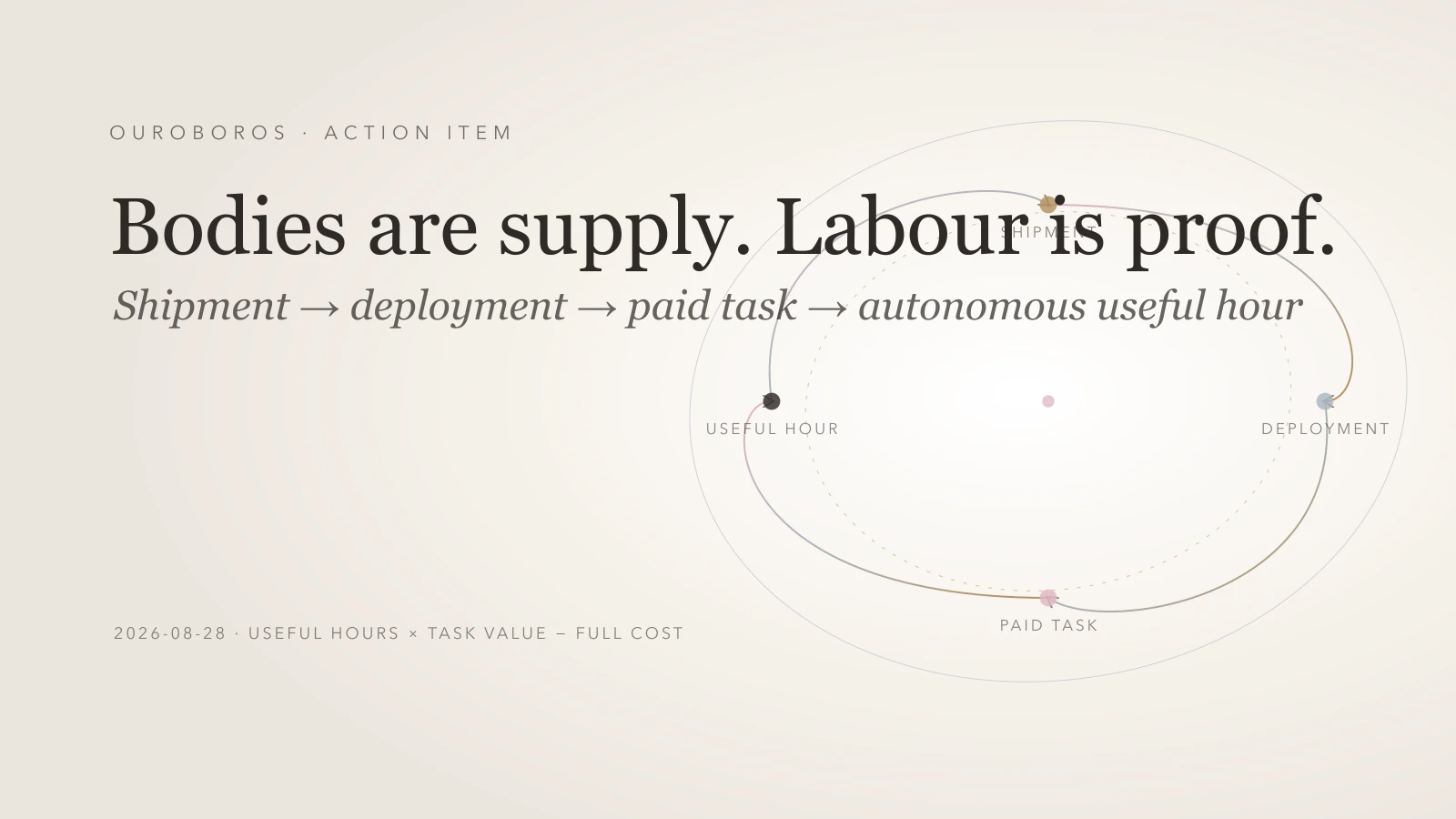
A commercial loop with a scoreboard.
The conclusion is a denominator
The conclusion is simple: China has established the strongest manufacturing position in the first humanoid-robot cycle, while the scarce economic output remains a paid autonomous useful-work hour. A body leaving a factory proves supply. A customer paying for a completed task with low intervention proves labor. Investors, operators and policymakers lose the distinction when one shipment number stands in for both.
A Reuters investigation estimates that about 20,000 humanoids shipped worldwide in 2025 and roughly 95% were made in China. That is an extraordinary industrial result. It reflects component density, supplier proximity, public support, rapid iteration and aggressive pricing. The same reporting finds limited factory use, brittle performance outside familiar conditions and expectations of consolidation from 2027. Both statements can be true: China can dominate body production while the industry remains early in labor production.
The investment decision is BUILD — USEFUL_LABOR_LEDGER. Every humanoid company should move through four observable gates: shipment, external deployment, paid task, autonomous useful hour. Each gate needs its own numerator, denominator and source. A company earns a higher commercial rating only when the later gates expand with repeat orders, lower intervention and acceptable safety.
This framework avoids two expensive errors. The first is dismissing China’s lead because current robots remain limited. Manufacturing scale creates learning, cost reduction and supply-chain power. The second is capitalizing every shipped body as future labor. Useful work requires intelligence, reliability, integration, service and economics that survive outside a controlled demonstration.
A shipment is an industrial fact
The 95% figure matters. Humanoids combine actuators, reducers, sensors, batteries, power electronics, structural parts, hands, compute, cooling and final assembly. A country able to coordinate those inputs at volume can lower unit cost, shorten design cycles and expose more hardware to real-world failure. Scale also attracts tooling, repair capacity and skilled suppliers. These effects compound.
Unitree’s company history illustrates the speed of this learning loop. It records successive quadruped and humanoid releases, mass-facing demonstrations and 2026 tests of an embodied model inside its own manufacturing facility. Those disclosures are company claims, so they belong in a capability column. They still show how a domestic manufacturer can connect hardware production, data collection and iteration under one roof.
China also has a deep installed automation base. The International Federation of Robotics reports that China installed about 295,000 industrial robots in 2024, represented 54% of global installations and held more than two million robots in operational stock. Industrial arms and humanoids serve different tasks, yet the surrounding integration skills, component vendors and factory customers provide useful infrastructure for the new category.
Manufacturing lead therefore deserves a CONFIRMED label at the body layer. The estimate for humanoid shipments comes from reporting rather than a complete audited census, so the exact 95% remains REPORTED. The broader direction is well supported. China has more physical units, lower-cost supply and more opportunities to discover hardware failure than its competitors.
The labor funnel starts after shipment
Commercial evidence should pass through a funnel:
body manufactured
        ↓
body shipped to an external customer
        ↓
body deployed in a live workflow
        ↓
paid task completed to specification
        ↓
autonomous useful hour with measured intervention and cost
Each step removes a different source of inflation. A manufactured body may remain in inventory or inside the vendor’s own facility. A shipment may be a pilot, internal transfer or subsidized trial. A deployed robot may collect data while humans perform most judgment through teleoperation. A completed task may be too slow, unreliable or expensive to repeat. An hour of motion may contain little customer value.
The funnel also clarifies what teleoperation means. Human control is valuable for training, exception handling and early service delivery. It belongs in the cost and intervention record. Calling teleoperated time autonomous hides the labor that produced the result. Calling every demonstration a deployment hides who paid, how often the task ran and whether the customer renewed.
The useful-hour denominator requires an external task definition. “Robot operated for ten hours” is weaker than “robot loaded 900 parts meeting quality tolerance during a ten-hour shift, with eighteen minutes of human intervention and zero safety events.” The second statement has work output, duration, intervention and quality. It can be compared with a human process and priced.
Useful labor is an economic equation
The core equation is:
net useful-labor value
= autonomous useful hours × task value per hour
− human intervention
− safety and supervision
− maintenance and downtime
− energy and facilities
− depreciation and financing
− integration and software
“Autonomous useful hours” excludes charging, waiting, planned maintenance, recovery, remote operation and failed work. Task value should reflect the customer’s avoided or expanded cost rather than a vendor’s list price. A warehouse may value throughput during an unpopular shift. A factory may value injury reduction in an awkward station. A home may value reliability and privacy more than raw speed. The unit is economic output, not choreography.
Intervention must include visible and hidden humans. Visible intervention covers teleoperators, safety staff and technicians. Hidden intervention includes data labeling, site engineering, workflow redesign, remote diagnostics and model-specific exception handling. Some of these costs decline with fleet scale. The decline needs evidence from comparable deployments.
Depreciation matters because humanoid hardware is changing quickly. A body can remain mechanically functional while its compute, hands or sensors become commercially obsolete. Financing a three-year asset against a one-year design cycle creates residual-value risk. Software upgrades may extend life, while a new task may demand different hardware. The ledger should record both physical life and economically useful life.
China owns the body-learning loop
China’s advantage is strongest where cost and iteration depend on physical coordination. Local suppliers can alter an actuator, gearbox or hand, feed the change into assembly, test it and scale it quickly. More bodies generate more component failures and more production knowledge. Lower prices widen the set of buyers willing to experiment.
The Financial Times industry analysis adds context around the competitive structure. Public support and industrial policy can accelerate capacity before end-market economics become clear. This can create useful learning and excess capacity at the same time. Consolidation becomes a feature of the cycle rather than proof that the original manufacturing thesis was wrong.
Scale can also compress hardware margin. If bodies standardize, value migrates to reliable hands, safety systems, embodied models, proprietary data, workflow integration and fleet operations. Chinese vendors may capture those layers, yet manufacturing share alone cannot guarantee it. The transition resembles other hardware markets where supply leadership created a base and software or distribution determined much of the profit pool.
For Robin, the strategic reading is constructive. China should remain the reference point for bill of materials, unit-cost decline, supplier velocity and installed-body learning. It deserves deeper observation instead of a narrative shortcut. The question is which firms turn the body advantage into repeatable customer output before prices erase their ability to fund service and intelligence.
US leaders are building the intelligence loop
US firms currently disclose stronger examples of model-centric control, developer capital and data strategy. Figure reports that its F.02 deployment at BMW ran weekday ten-hour shifts, accumulated more than 1,250 runtime hours, loaded more than 90,000 parts and contributed to more than 30,000 vehicles. The Figure deployment account is issuer-supplied and needs customer-side confirmation for full underwriting. It is still more useful than a generic shipment figure because it names a site, task, duration and work output.
Figure’s Helix 02 disclosure describes a four-minute autonomous kitchen task, 61 sequenced actions and no human intervention during the demonstration. This is evidence of integrated locomotion and manipulation. It remains a controlled demonstration rather than paid labor. The correct ledger records both the capability gain and the missing commercial denominator.
1X’s World Model Lab announcement explains its data loop: web media, egocentric human video, simulation, remotely operated robot data and on-policy fleet data feed deployment and reinforcement learning. The company says factory capacity is live and fleet scale is no longer the bottleneck. That is a strategic claim. Customer task hours, intervention and renewal remain the evidence needed for commercial validation.
These examples show the US advantage in model development, data acquisition and capital. They also reveal a cost: data pipelines and remote operation can make robots appear more autonomous than their current economic state. A strong investor reads training infrastructure as an asset and keeps it outside the autonomous-labor numerator.
Four platforms need four readings
Unitree should be judged first on manufacturing economics and hardware reliability. Track external shipments, realized selling prices, warranty expense, field failures, paid deployments and the share of work performed without remote control. Public demonstrations belong in capability. Factory customer renewals belong in labor.
Figure offers the clearest disclosed bridge from model capability to a named industrial workflow. Track customer-confirmed hours, station count, task throughput, intervention, quality rejects, safety, fleet uptime and renewal. The BMW figures create a baseline. Expansion across stations and customers would provide stronger evidence than another polished home demo.
1X is a data and home-deployment thesis. Track how many homes pay, what tasks recur, how often remote operators intervene, the privacy model for collected data, service cost per home and retention after novelty fades. Home environments offer rich data and high variability. They also impose demanding safety, trust and support costs.
Conventional industrial robotics provides the control group. Fixed automation may lack generality and still win on uptime, speed, safety certification and cost. A humanoid should earn a workflow when flexibility, fast reconfiguration or human-shaped access compensates for lower task-specific efficiency. Human form is an interface choice, not an economic entitlement.
The underwriting scorecard
Every company should publish or privately provide the same scorecard:
| Layer | Required measure | Evidence status |
|---|---|---|
| Supply | bodies manufactured and externally shipped | audited or customer-reconciled |
| Deployment | paying sites, stations and active days | customer-confirmed |
| Work | successful paid tasks and quality yield | workflow telemetry |
| Autonomy | useful hours net of teleoperation and recovery | independently defined |
| Reliability | uptime, mean time between failures and intervention | comparable fleet cohort |
| Safety | incidents, near misses and restricted operating conditions | complete event policy |
| Economics | revenue per useful hour and fully loaded cost | contract and cost evidence |
| Retention | repeat orders, expansion and renewals | customer cohort |
Missing values stay UNKNOWN. A missing intervention rate cannot become zero. A vendor-selected video cannot become fleet uptime. A letter of intent cannot become revenue. A body shipped to an affiliate cannot become external demand. This discipline protects upside because progress becomes visible at the correct layer.
The decision ladder is equally compact. WATCH applies when body scale or capability grows without paid-work evidence. INVESTIGATE applies when named customers and tasks exist while economics remain incomplete. UNDERWRITE applies when useful hours, intervention, safety, cost and retention form a comparable cohort. ALLOCATE requires price, governance, liquidity and downside terms in addition to operating proof.
What changes the thesis
The thesis upgrades when Chinese vendors report customer-confirmed repeat deployments alongside lower intervention and stable safety; when US leaders move from demonstrations to economically measured fleets; when useful-hour cost falls faster than selling price; and when service revenue supports maintenance and continued model improvement.
The thesis weakens when shipments accumulate without active sites, pilots fail to renew, teleoperation remains structurally heavy, warranties absorb hardware margin, safety restrictions narrow the addressable tasks, or frequent redesign destroys residual value. Industry consolidation can accompany either path. The reasons for consolidation matter more than the count of survivors.
Robin’s operating action is to create one durable Physical-AI ledger with one row per company and one column per funnel gate. Update it only from dated, attributable evidence. Keep production share in the supply column. Keep demonstrations in capability. Keep externally paid autonomous useful-work hours in labor. The separation turns a noisy humanoid race into a sequence of verifiable investment decisions.
China built the bodies first. That is a meaningful advantage. Useful labor is the next product, and its unit is an hour a customer values enough to buy again.
Categories and keywords
Categories: Artificial Intelligence, Robotics, Investing
Keywords: autonomous useful work hours, humanoid robot economics, China robotics supply chain, embodied intelligence, robot deployment underwriting, Physical AI, intervention rate, fleet economics
Hashtags: #PhysicalAI #HumanoidRobots #Robotics #ChinaTech #AIInvesting