01 · AI Circularity Ledger
Why Xpeng Gave Robotics Its Own Balance Sheet
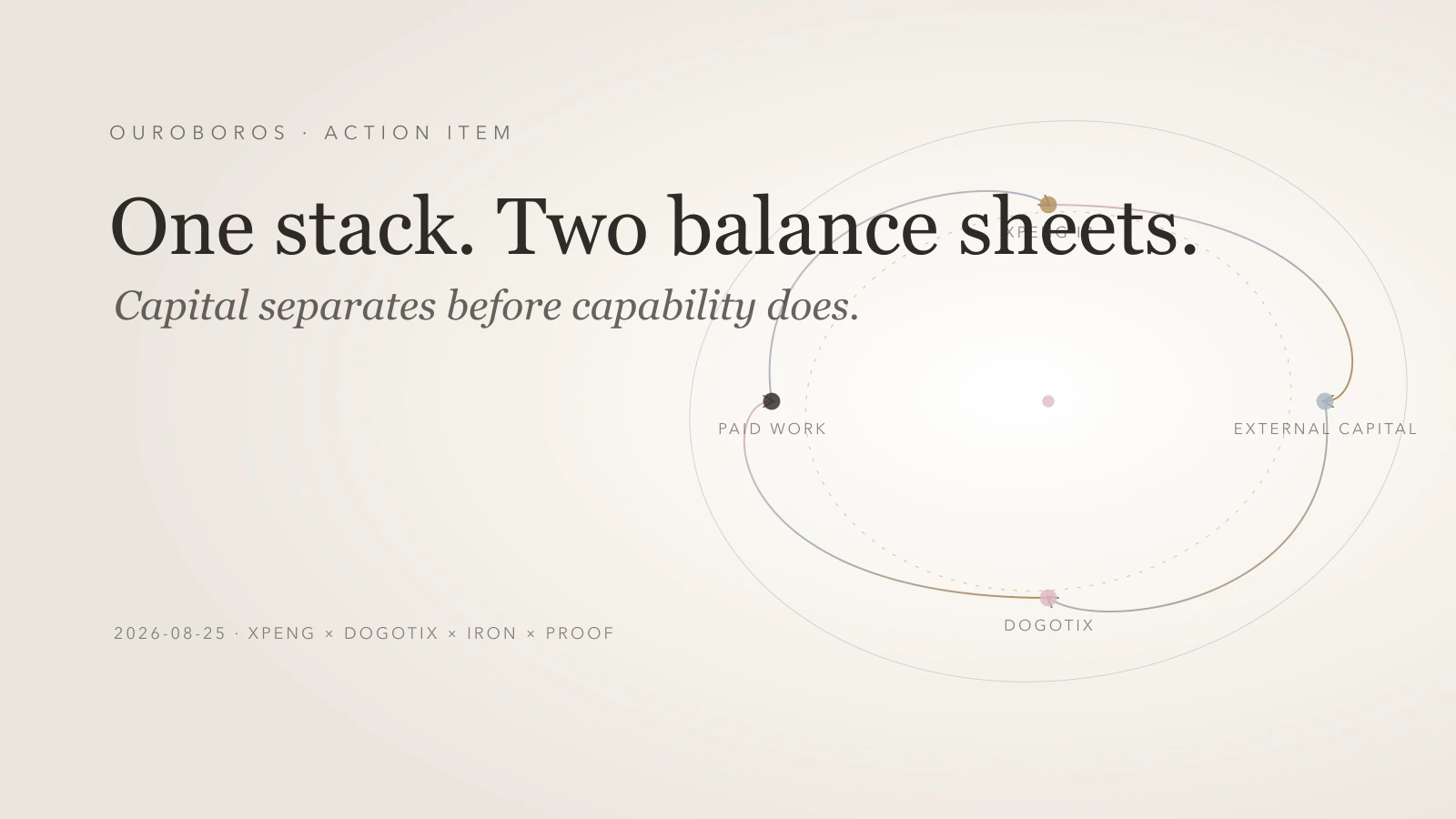
A commercial loop with a scoreboard.
The conclusion is a capital boundary
The conclusion is direct: Xpeng gave robotics its own balance sheet because a controlled subsidiary can reveal option value, attract specialist capital, isolate cash consumption, and preserve strategic control at the same time. The structure is intelligent. The valuation is still only a financing price. It says very little about whether a humanoid robot can perform paid work for long enough, cheaply enough, and independently enough to become a durable business.
Xpeng announced that Dogotix entered share-purchase agreements for more than $900 million at a post-money valuation above $6.3 billion. IDG Capital led the round, with Gaorong Ventures and strategic support from Tencent and Alibaba. Xpeng says it will retain control and continue consolidating Dogotix into group financial statements after closing. The agreements are conditional. The capital has been priced; the operating thesis has not yet been proved.
Reuters reported the transaction as China’s largest single private fundraising in embodied AI. A financing-structure account describes a mixture of new external money, Xpeng participation, and management capital. Exact fully diluted ownership, security rights, liquidation preferences, closing mechanics, and future funding obligations remain UNKNOWN until the relevant contracts or filings disclose them.
The useful decision is BUILD: CONTROLLED_CARVEOUT_SCORECARD. It separates five things that promotional language often mixes together: financing price, parent control, transferred assets, manufacturing capacity, and verified labor economics.
The transaction creates a price without creating independence
A carve-out is a legal and financial perimeter. It does not automatically create an independent company in economic substance.
Dogotix receives its own shareholders, governance documents, employee incentives, funding pool, and valuation reference. That gives robotics a visible cost of capital and creates a cleaner instrument for future fundraising. Specialist investors can buy exposure to the robotics option without underwriting every vehicle, robotaxi, and automotive cycle inside Xpeng. Employees can receive incentives linked to a robotics-specific value pool. The parent can show investors that outside capital is willing to validate a business hidden inside a larger group.
At the same time, Xpeng retains control and consolidation. That matters. Consolidation means Dogotix remains inside Xpeng’s reported economic boundary even after minority capital enters. The parent can retain strategic direction, shared technology, procurement leverage, brand association, and access to manufacturing. It also means losses, assets, liabilities, related-party transactions, and cash movements need careful reading at group and subsidiary levels.
The round therefore creates partial separation rather than clean independence. The right asset-and-capital map has four channels:
- Xpeng to Dogotix: robotics IP, people, physical assets, licences, data rights, shared services, and access to automotive-grade procurement and manufacturing.
- External investors to Dogotix: cash, board or consent rights, preference terms, strategic distribution, and expectations for a future liquidity event.
- Dogotix to Xpeng: potential dilution proceeds, service fees, shared-technology economics, consolidation effects, and strategic option value.
- Customers to Dogotix: orders, deposits, paid deployments, operating data, renewal, and the only cash flow that can ultimately validate the financing price.
The first three channels can exist before a robot earns one autonomous useful hour. The fourth channel is the proof.
The parent is selling risk boundaries rather than core capability
Xpeng’s advantage comes from combining systems already developed for intelligent vehicles: sensing, chips, batteries, control, AI models, software integration, supplier relationships, safety processes, and mass-manufacturing discipline. Its announcement says IRON uses three Turing AI chips, a full-stack in-house architecture, 76 body degrees of freedom, and 21 degrees of freedom in each hand. These are company claims about technical design. They are not evidence of paid labor output.
The more important question is which capabilities cross the carve-out boundary and on what terms.
Xpeng’s 2025 annual report records earlier investments in Dogotix and describes the company as focused on robots with human-robot interaction functions. That history shows the robotics vehicle existed before this financing. The new round appears to transform an internal or related strategic asset into a separately priced controlled platform.
That transformation can be valuable for three reasons. First, robotics capital expenditure and research spending become easier to identify and govern. Second, the company can recruit executives and engineers with equity tied to the robotics outcome. Third, future investors can fund a defined perimeter rather than sending capital into the automotive parent and hoping management allocates enough to robotics.
The carve-out can also conceal economic dependence if the perimeter is drawn loosely. A subsidiary may appear well funded while relying on the parent for factories, chips, engineering, data, guarantees, staff, distribution, or purchase commitments. Transfer pricing can make the subsidiary look stronger or weaker. Shared IP may restrict a future sale. Parent service agreements may become a permanent subsidy. These are not accusations. They are the normal diligence questions created by partial separation.
The scoreboard should record each asset as TRANSFERRED, LICENSED, SHARED, RETAINED_BY_PARENT, or UNKNOWN. It should apply the same labels to people, facilities, data, foundation models, Turing chips, robotaxi technology, procurement contracts, manufacturing lines, and customer relationships.
Tesla provides the useful opposite structure
Tesla keeps Optimus inside the listed parent. Its filings describe Optimus as part of a broader Physical AI strategy supported by real-world AI data, internal manufacturing, and expanding training infrastructure. A Tesla filing presents the robot alongside autonomous driving and the company’s transition toward Physical AI.
Keeping robotics inside the parent has clear advantages. Shared engineers and infrastructure move without elaborate related-party agreements. The company avoids minority protections, subsidiary governance friction, and debates over which entity owns future improvements. If Optimus succeeds, all value belongs to Tesla shareholders. If vehicle cash flow funds the build, Tesla does not need to accept an external valuation before the product matures.
The cost is opacity and capital competition. Investors cannot buy the robot option separately. Robotics spending competes with vehicles, batteries, autonomy, factories, charging, and other corporate priorities. A weak robotics business can hide inside a much larger cash-flow system. A strong one may remain undervalued because outsiders cannot observe its economics.
Xpeng chose a different bargain. It accepted minority capital and a visible financing price while retaining control. The parent preserves upside, gains external funding, and creates a dedicated incentive pool. In exchange, it must define the perimeter, respect new investor rights, and explain transactions between the entities.
Neither architecture is universally superior. The decision depends on capital intensity, strategic overlap, managerial attention, investor appetite, and the observability of operating proof. A carve-out works when it creates discipline without severing the capabilities that make the business competitive. Internal retention works when the parent can fund the option and disclose enough evidence to prevent the project from becoming an unmeasured ambition.
Six proofs must replace the financing headline
The $6.3 billion figure is a starting point for questions. It is not the answer.
First, closing proof. Record whether the agreements close, the cash actually received, the securities issued, the fully diluted ownership, and every material preference or redemption right. Until then, more than $900 million is CONDITIONALLY_COMMITTED, not cash in the bank.
Second, perimeter proof. Publish a plain-language schedule of what enters Dogotix and what stays with Xpeng. The schedule should cover patents, model weights, source code, data, engineers, factories, tooling, supply contracts, trademarks, and distribution rights. Every related-party agreement needs duration, pricing logic, termination rights, and change-of-control treatment.
Third, output proof. Xpeng says IRON is expected to enter mass production by the end of 2026, with initial deployment in Xpeng stores and campuses before broader deliveries in 2027. The second-quarter results repeat the conditional Dogotix financing and provide group financial context, including a June cash position of RMB40.48 billion. Guidance becomes evidence only when monthly completed units, accepted units, yield, rework, and field availability are reported.
Fourth, customer proof. Internal deployment is useful for learning, though it can also make demand circular. The decisive customer is an external party that pays from its own budget, specifies a job, accepts performance, and renews or expands. Store appearances and campus trials belong in PILOT until commercial terms and an operating denominator are visible.
Fifth, useful-work proof. The August 22 autonomous useful-hours framework defines the denominator: sixty minutes of an agreed customer workflow, within the operating envelope, without unplanned human control, while meeting quality and safety thresholds. Units shipped do not reveal remote intervention, reset labor, downtime, rejected work, or exception handling. Dogotix should be evaluated on autonomous useful hours, intervention frequency, cost per useful hour, and paid renewal.
Sixth, funding proof. Record quarterly cash consumption, committed capital expenditure, parent cash contributions, guarantees, shared-service balances, and the runway to the next externally verifiable milestone. A high valuation can reduce dilution while simultaneously encouraging a spending plan that assumes the next round will always be available.
These proofs turn a financing announcement into a monitoring system.
The carve-out scorecard
RobinOS should maintain one compact card rather than a celebratory valuation chart.
| Field | Current treatment | Upgrade evidence |
|---|---|---|
| Financing | More than $900 million conditionally committed | closing notice, cash receipt, security terms |
| Valuation | Above $6.3 billion post-money | fully diluted capitalization and preferences |
| Control | Xpeng says it will retain control and consolidation | filed ownership and governance rights |
| Asset perimeter | Partial public description | complete transfer, licence, and shared-service schedule |
| Production | mass production targeted by end-2026 | monthly completed and accepted units, yield, downtime |
| Customers | initial Xpeng stores and campuses | named external paying customer and contract scope |
| Autonomy | technical claims and demonstrations | useful hours, intervention, quality, safety, uptime |
| Economics | UNKNOWN | price, gross margin, service cost, cash burn, renewal |
| Parent exposure | UNKNOWN | contributions, guarantees, shared costs, maximum loss |
| Exit path | implied future standalone value | governance, liquidity rights, IPO or sale conditions |
The card needs three separate verdicts. FINANCING_PRICE records what investors paid. CAPABILITY records what the system can reliably do. COMMERCIAL_MATURITY records whether customers pay for the work at sustainable economics. No verdict substitutes for another.
Governance should preserve one more distinction: valuation validation and business validation happen on different clocks. A sophisticated investor can rationally pay today for access to talent, supply chains, strategic relationships, and a long-dated robotics option. That transaction validates demand for the security. It does not validate demand for the robot’s labor. Conversely, a modest early customer contract may reveal more about commercial maturity than a large preferred-equity round. The monitoring system should therefore date every observation and forbid later evidence from rewriting the original state. The August financing remains a financing event. A future factory milestone remains a manufacturing event. A customer renewal remains a commercial event. Keeping those events separate prevents an impressive result in one domain from silently upgrading all the others.
The scorecard also needs explicit failure cases. If the company reaches its unit target while intervention remains high, manufacturing succeeded and autonomy failed. If Dogotix wins paid pilots without renewal, sales succeeded and recurring economics failed. If outside capital closes while Xpeng continues to fund most operating losses, the financing boundary exists legally and remains weak economically. If the parent restricts IP or data so tightly that Dogotix cannot operate independently, the standalone valuation deserves a dependency discount.
The next proof
The smallest next step is to add Xpeng IRON to the Physical AI tracker with four gates: actual monthly output, external paying customers, autonomous useful hours, and intervention rate. Each field stays UNKNOWN until a dated source supplies the relevant denominator. The financing round should be recorded as CONDITIONALLY_COMMITTED; commercial maturity remains HOLD.
Success is measurable. Within five minutes, another investor should be able to distinguish cash committed from cash closed, Xpeng control from Dogotix independence, manufacturing guidance from accepted output, and shipped robots from paid autonomous work.
That distinction explains the carve-out. Xpeng did more than raise money for a robot. It created a second balance sheet so the robotics option could have its own capital, incentives, and valuation while the parent retained the system that made the option credible. The architecture is promising because it makes risk visible. It becomes valuable only when customers, useful hours, and cash flows cross the same boundary.
Categories and keywords
Categories: Physical AI; Robotics; Corporate Finance; Capital Allocation; Autonomous Labor
Keywords: Xpeng; Dogotix; IRON; robotics carve-out; post-money valuation; minority capital; useful work hours; intervention rate; related-party agreements
Hashtags: #PhysicalAI #Robotics #CorporateFinance #CapitalAllocation #HumanoidRobots #ArtificialIntelligence #AutonomousLabor #RobinOS