BUILD · Research → story
What comes back from orbit
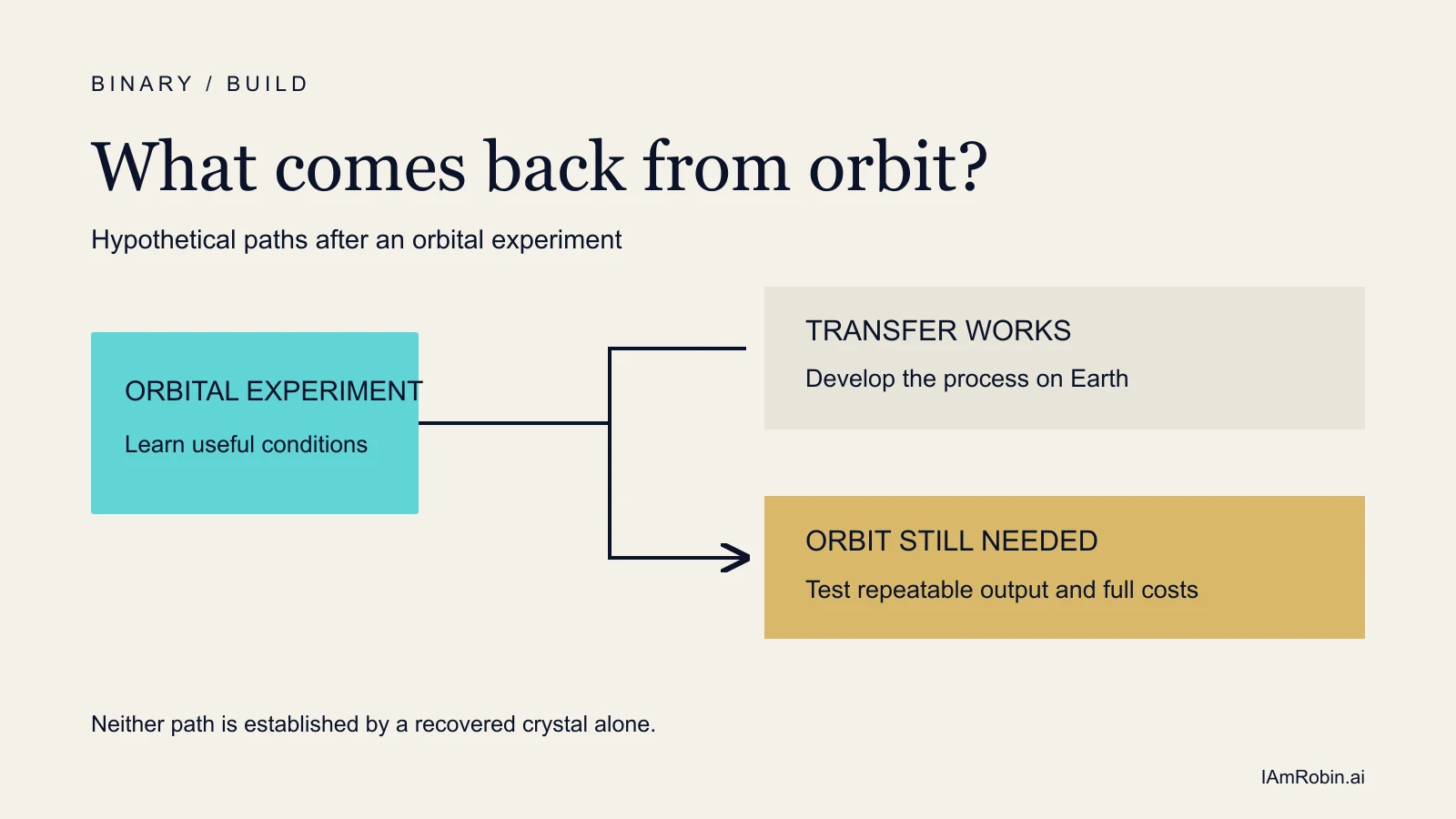
An orbital experiment can return material and knowledge. Those lead to different businesses.
The surprising passenger in Varda’s orbital drug experiment is the ground control. It stayed on Earth and also produced ritonavir Form III.
The April 2026 paper reports that the form made in orbit survived the return. Its terrestrial experiment used duplicate hardware and produced the same crystal form. That is a useful result with a precise boundary: a successful space experiment does not establish that making this form requires space. Nor does matching the crystal form establish equivalent purity, stability or production economics. Varda participated in the study, and the paper discloses employee financial interests.
That detail opens a more interesting design question. What should come back from an orbital laboratory: a material we need to keep making up there, or knowledge we can use down here?
Imagine the second factory
Suppose a future orbital experiment reveals a useful processing condition. Researchers bring the result home, investigate why it worked, then reproduce the useful properties in a terrestrial process. This is a hypothetical path, not the history of Form III in this paper. The ground process there was already part of the experiment.
In our imagined case, the first flight helps the team learn. The second factory can sit on Earth. The research might still have value even if the team no longer needs an orbital trip for every batch.
Now change one condition. Suppose the useful properties cannot be reproduced by the best available terrestrial process, and the advantage survives return and storage. Every accepted batch may then require another orbital processing cycle. Launch access, recovery and rejected output become recurring production questions.
These two projects can share a photograph of a capsule. Their next engineering tasks differ. One team tries to transfer a process. The other tries to repeat it at a cost a customer can justify.
Let the cheaper process compete
A revealing test would give a terrestrial team the information learned from orbit and ask it to match the target product attributes. Compare equivalent analytical methods and a defined storage period. Success would support transfer for that particular process. Failure would justify further investigation, with a stated search budget; it would not prove that Earth can never match it.
This test also prevents a convenient mistake: comparing a carefully developed orbital process with a neglected ground control. The relevant alternative can improve after researchers learn what to look for.
Commercial questions follow the result. A transferable process might support research fees or licensing, if customers pay and the rights permit it. Recurring orbital production would need repeatable accepted output and a full cost comparison. Neither revenue model follows automatically from a scientific result, and this story estimates neither.
The October 1 Special asks what evidence would connect Varda’s processing to a useful drug product. Here the question is narrower: how often would that product need to leave Earth? Before counting factories in orbit, find out whether the most useful thing brought home could be the instructions.