BUILD · Research → story
The clock moved. The quote did not.
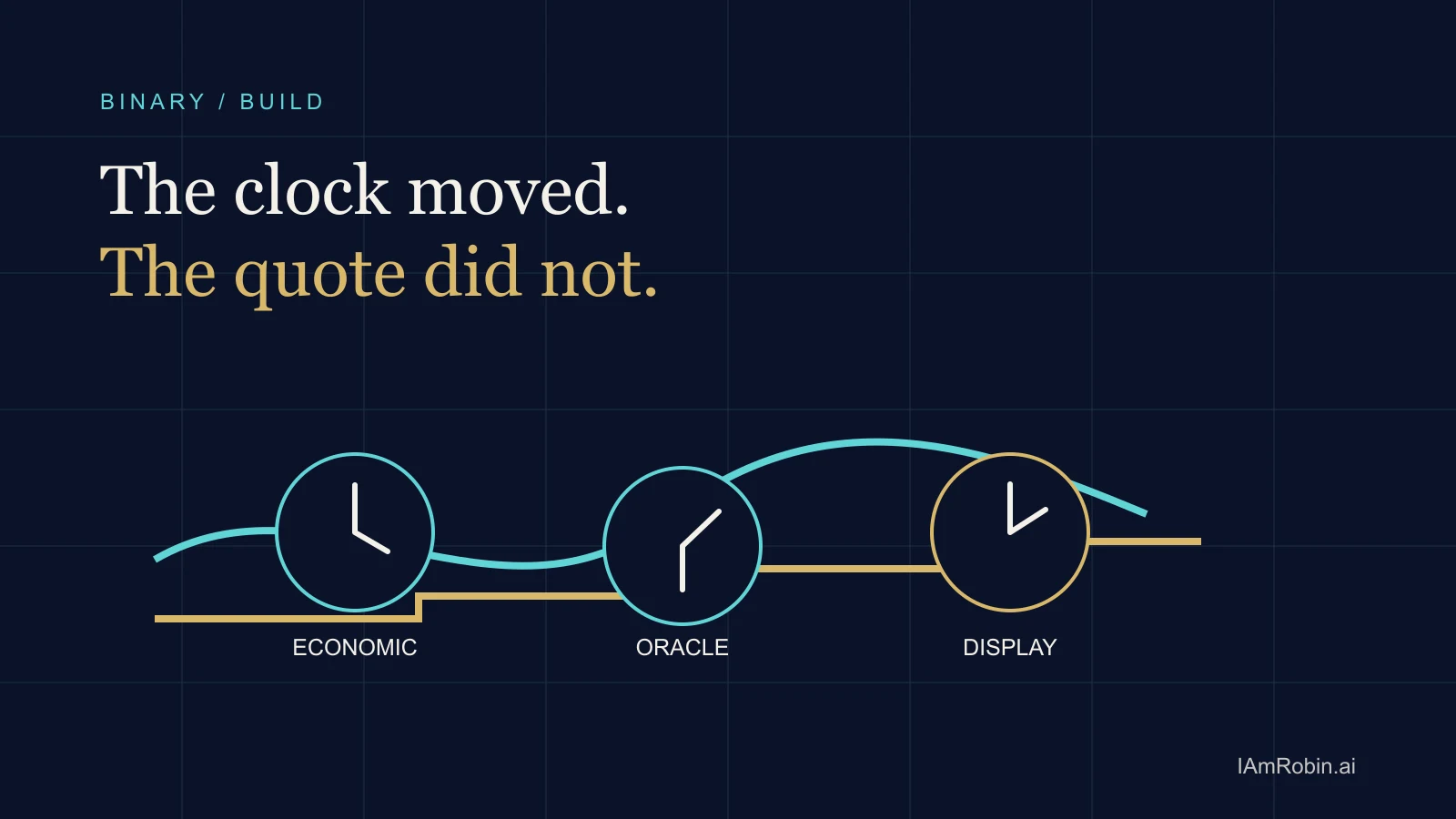
USDY began accruing price by the second. A one-token quote still stayed unchanged because the display had a coarser clock.
The clock moved. The quote did not.
On 1 November 2026, Ondo changed USDY’s official price calculation from a daily step at 00:00 UTC to continuous accrual. The new oracle calculates elapsed yield down to the second. That sounds as if every visible quote should move every second.
For one USDY quoted in six-decimal USDC, it did not.
The contradiction is useful because it separates three clocks that financial software often compresses into one number: the economic clock, the accounting clock and the display clock.
Three clocks, one balance
The economic clock is the underlying accumulation. USDY is designed so that holders keep the same token count while the value per token rises with yield from Treasury and bank-deposit assets.
The accounting clock is the oracle rule. The former schedule held the price flat through the day and booked a daily increase at midnight. The new ContinuousPriceOracle stores a price and annual rate, then calculates accrued value for the exact request time.
The display clock is the precision of the output a person or another program receives. USDY’s oracle uses 18 decimal places. USDC amounts use six. Ondo’s published conversion arithmetic rounds down when it turns the high-precision USDY value into a USDC amount.
A more precise accounting clock can therefore advance beneath a coarser display clock.
One second that disappears
The source Special froze Ethereum state at block 26,345,421 and simulated later timestamps without signing or sending a transaction. Across one selected midnight, the new official price rose from about $1.152259433 per USDY to $1.152259434. The one-second increase was approximately $0.000000001345 per token.
The legacy schedule behaved differently. It crossed its daily booking boundary and added approximately $0.00011623 at once.
Both calculations represented accumulation, but they placed it on different timelines. The old schedule concentrated a day into a step. The new oracle spread the calculation across elapsed seconds.
Then the display removed the visible difference. Immediately before midnight, at midnight and one second later, the gross one-USDY quote was 1.152259 USDC each time. The underlying oracle value had moved. It had not moved far enough to reach the next millionth of a USDC after rounding down.
That is not a frozen price. It is a moving value viewed through a larger unit.
Smoother accounting does not guarantee smoother screens
Continuous accrual removes the artificial concentration of a full day’s increase at midnight. It supports calculations during the day, weekend and holidays. But a user interface can still update in visible steps because its quote asset, decimal precision, lot size or refresh cadence creates another threshold.
The threshold also scales with quantity. A one-token quote may hide a one-second increment that a larger amount exposes sooner. This does not make the larger quote economically superior; it only changes when the rounded output crosses its smallest visible unit.
The implementation lesson is simple: precision is a stack, not a single property.
- State the timestamp represented by the oracle value.
- Preserve high precision through intermediate calculations.
- Define the final rounding direction and output decimals.
- Test boundaries with the actual quote asset and quantity.
- Do not infer “no accrual” from an unchanged rounded display.
Those rules matter anywhere a continuously changing input becomes a discrete payment, balance or user-facing number.
The wrapper is part of the clock
Ondo also provides a stable USDYOracleWrapper address. On Ethereum, the observed wrapper pointed to a scheduled switch that routed requests from the old oracle to the new one at the cutover time.
That separation matters. An integration needs both a dependable address and a clear time rule. Software that uses the wrapper can keep asking the same place while the implementation behind it changes. Software that reads the former oracle directly must migrate if it wants the current official calculation.
Ondo expects to deprecate the former oracle on 31 December 2026. That remained a future plan at the 5 November research cutoff, not an observed shutdown.
The stable address does not remove integration work. Historical-price requests, rounding behavior and application display logic still need explicit treatment. It does, however, make one responsibility clear: the wrapper owns where the current price is requested; the application owns how that high-precision answer becomes a visible quote.
A precise result with a bounded meaning
The read-only exercise established a calculation mechanism under frozen settings. It did not execute a redemption or prove a holder’s proceeds. Fees, eligibility, service pauses, limits, liquidity and settlement remained outside the test.
That boundary strengthens the lesson. The result does not need a trading claim to be useful.
The oracle can count every second while the screen appears still. The apparent contradiction disappears once the clocks are separated:
- economic value accumulates;
- the oracle calculates at request time; and
- the quote changes only when rounding allows it.
When a financial number looks frozen, ask which clock you are actually watching.
Sources: Ondo’s continuous-pricing announcement, USDY Price Oracle documentation, USDY InstantManager integration documentation, Ondo contract addresses, the reviewed contract source, and the hash-bound source Special.